
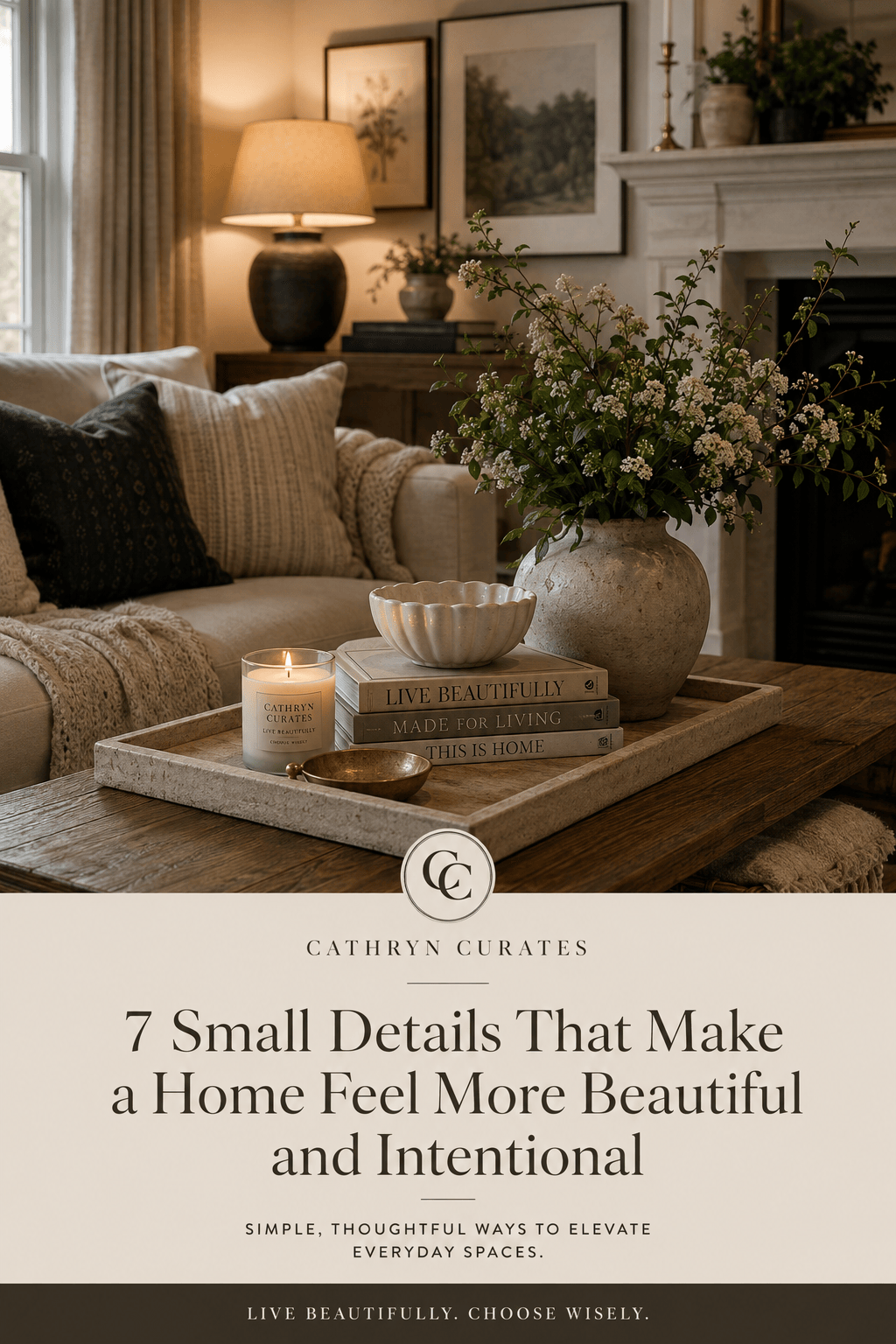
A beautiful home does not have to be extravagant, perfectly styled, or constantly changing. Intentional home styling is often less about adding more and more about paying attention to the details already around you. More often, the spaces that feel the most inviting are the ones where someone has paid attention to the details: how a room is lit, what is left visible, how everyday objects are arranged, and whether the space supports the way people live.
The goal is not perfection.
It is intention.
Here are seven small changes that can make a home feel noticeably more beautiful, comfortable, and considered.
1. Create One Beautiful Moment in Every Room
You do not need to redesign an entire room to change how it feels.
Instead, create one small focal point.
It might be a vase of flowers on a console table, a favorite bowl on the kitchen island, a beautifully styled nightstand, or a stack of books beside a candle.
A single intentional moment gives the eye somewhere to rest and makes the room feel finished without making it feel overly decorated.
2. Pay Attention to Lighting
Few things change the mood of a home as quickly as lighting.
Bright overhead lighting may be necessary sometimes, but softer layers of light generally make a space feel warmer and more welcoming.
Try combining table lamps, floor lamps, sconces, candles, and natural light rather than relying on one central fixture.
The goal is not simply to illuminate a room.
It is to create atmosphere.
3. Make Everyday Objects Worth Seeing
Some of the most frequently used things in our homes have to remain visible.
Rather than fighting that, make them part of the design.
A beautiful tray can hold hand soap and lotion. A ceramic crock can contain kitchen utensils. Woven baskets can conceal everyday clutter. A glass jar can make something as ordinary as laundry detergent or bath salts feel considered.
Useful, beautiful, thoughtful home decor do not have to be opposites.
4. Edit Before You Add
When a room feels unfinished, the instinct is often to buy something new.
Sometimes the better answer is to remove something.
Clear a surface. Reduce the number of decorative objects. Put away items that no longer serve the room. Leave a little empty space.
Visual breathing room makes the things you intentionally keep feel more important.
Before adding another object, ask:
Would this room feel better with less?
5. Bring in Something Living
Flowers, branches, herbs, and greenery add something artificial décor cannot quite replicate.
They soften hard surfaces, introduce movement, and make a room feel alive.
And they do not have to be elaborate.
A handful of grocery-store flowers, branches clipped from the yard, or a small potted herb in the kitchen can completely change a space.
6. Repeat Materials and Colors
A home begins to feel cohesive when certain elements quietly repeat themselves.
You might carry warm wood through several rooms, repeat brass accents, use similar cream textiles, or echo one muted color throughout the house.
The repetition does not need to be obvious.
In fact, it is often more effective when it is subtle.
Those small connections are what make separate rooms begin to feel like parts of one home.
7. Let Your Home Reflect Your Actual Life
Perhaps the most important detail is also the easiest to overlook.
A beautiful home should work for the people who live there.
Keep books where you actually read them. Create storage where clutter naturally accumulates. Put a chair near the window if that is where you like your morning coffee. Keep a basket near the stairs if things constantly need to travel between floors.
Good design should make everyday life easier, not require everyday life to accommodate the design.
Beautiful Does Not Have to Mean More
The most memorable homes are not necessarily the largest, newest, or most expensive.
They feel cared for.
They contain useful things chosen thoughtfully, meaningful things displayed intentionally, and enough breathing room for life to happen comfortably.
That is the kind of beauty worth creating.
Live beautifully. Choose wisely.

