
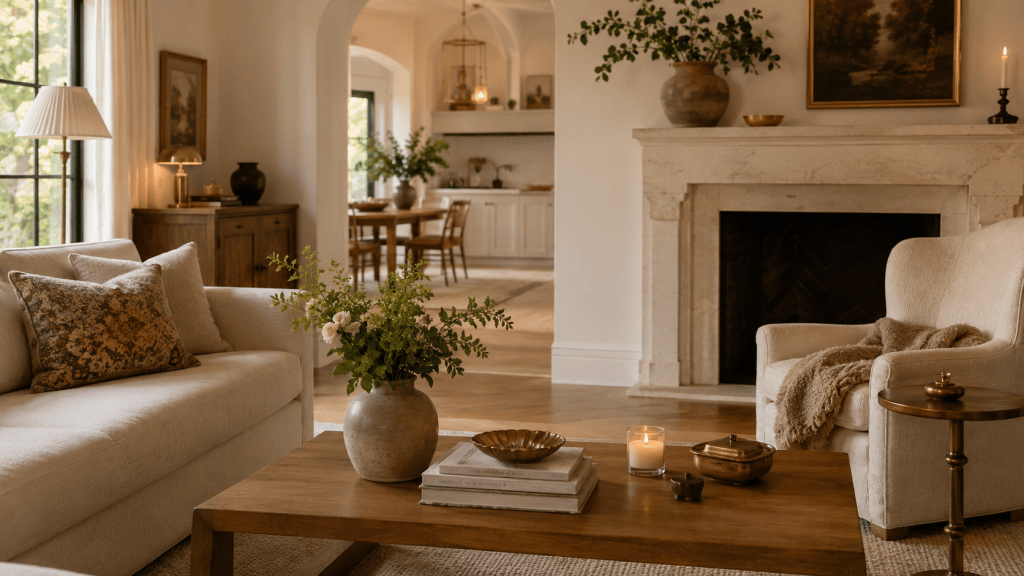
There is a particular ease to a home that feels collected.
It is not empty, but it is not crowded. It contains objects with personality, yet the room still has space to breathe. Nothing feels as though it arrived all at once or was purchased simply to fill a surface.
A collected home feels layered over time.
That does not require years of antiquing, a large decorating budget, or perfectly styled rooms. More often, it comes from knowing what deserves to stay, what deserves space, and how individual pieces relate to one another.
The goal is not to own less for the sake of minimalism.
The goal is to create enough visual order that the things you genuinely love can be seen.
1. Edit Before You Add
When a room feels unfinished, the instinct is often to buy something else.
Before adding, remove.
Clear the surface. Step away. Then return only the pieces that are useful, beautiful, meaningful, or necessary.
Often, a room does not need another object. It needs more distinction between what matters and what has simply accumulated.
This is one of the ideas behind 7 Small Details That Make a Home Feel More Beautiful and Intentional: beauty often comes from attention rather than addition.
2. Give Each Surface a Purpose
Not every horizontal surface needs to become a display.
A console may hold a lamp, a small stack of books, and one meaningful object. A kitchen counter may need breathing room more than another decorative accessory.
Ask what the surface is actually there to support.
When function is clear, styling tends to become simpler.
3. Mix New Pieces With Things That Have a Story
A room filled entirely with objects from the same season, store, or collection can be beautiful but still feel impersonal.
Collected rooms usually contain some contrast.
A new lamp beside an inherited bowl. A modern chair near an older wooden table. A framed photograph next to a recently purchased art book.
Not everything needs provenance. But a few pieces with history or personal meaning can keep a room from feeling staged.
4. Repeat Materials and Tones
Variety creates interest. Repetition creates cohesion.
If warm wood appears in one area, allow it to appear quietly somewhere else. If you love aged brass, repeat it without turning every metal finish into brass. If creamy linen, woven texture, or soft black appears once, echo it elsewhere.
The repetition does not need to be exact.
It simply gives the eye something familiar to follow through the room.
5. Vary Height, Scale, and Shape
A collection becomes clutter when everything competes at the same visual level.
Try combining something tall, something lower, and something with a different shape.
A lamp, a small bowl, and a stack of books create more rhythm than five objects of similar height lined across a surface.
Scale matters too. Sometimes one substantial piece creates more impact—and more calm—than several smaller accessories trying to occupy the same space.
6. Protect Negative Space
The empty areas are part of the room.
A blank portion of wall, an open section of countertop, or space between objects gives the eye somewhere to rest.
This is particularly important in homes where real life is happening.
Mail arrives. Coffee cups appear. Bags get set down. A room needs enough breathing room to accommodate daily living without immediately looking disordered.
That is also why simple systems matter. The principles on the Order page are not separate from beautiful interiors; good organization protects the visual calm that lets a room feel intentional.
7. Let Useful Things Be Beautiful
Some of the most successful objects in a home are the ones you would need anyway.
A substantial cutting board. A beautiful hand soap bottle. A woven basket that actually holds something. A bedside lamp with the right light. A ceramic bowl used every day.
When ordinary objects are chosen thoughtfully, there is less pressure to decorate around them.
Function becomes part of the visual language of the home.
8. Stop Before the Room Feels “Finished”
A collected home is rarely finished.
That is part of its appeal.
Leave room for the book you have not discovered yet, the photograph you have not framed, the piece you may bring home from a future trip, or the object someone you love may eventually give you.
A room that is completely filled has nowhere to evolve.
A room with a little space can continue becoming yours.
The Best Rooms Feel Personal, Not Perfect
A beautiful home does not need to demonstrate how much you own or how well you can style a shelf.
It should reveal something about the people who live there.
Keep what is useful.
Make room for what is meaningful.
Let beauty and function coexist.
And when the room begins to feel crowded, remember that the answer may not be another purchase.
Sometimes the most beautiful thing you can add is space.
Live beautifully. Choose wisely.

