
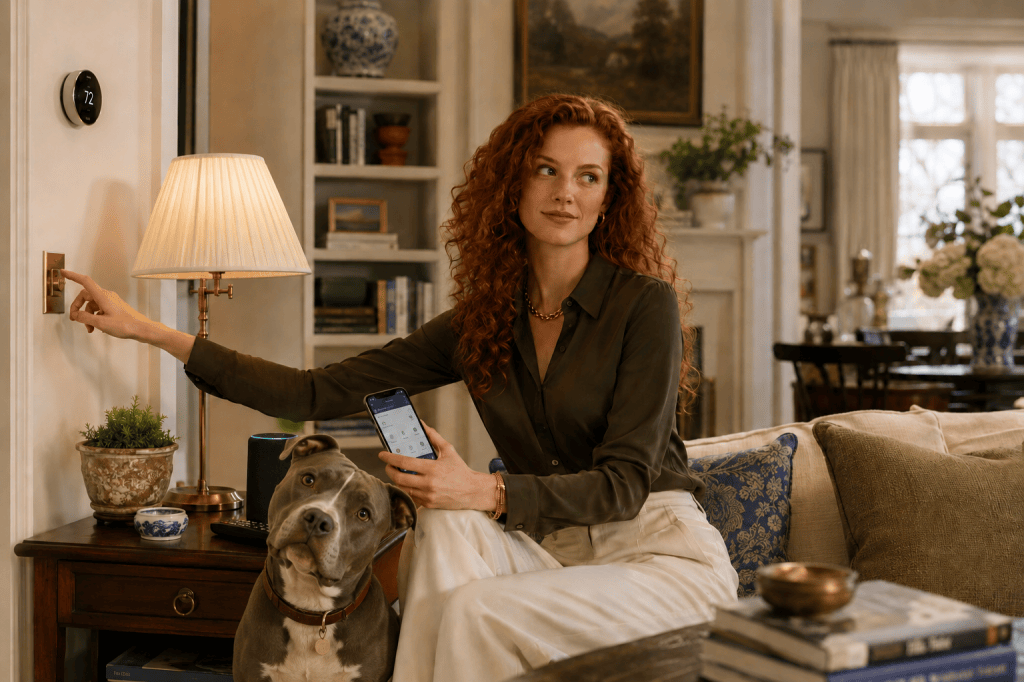
When convenience becomes one more thing to charge, update, troubleshoot, and remember the password for.
At some point, simply turning on a lamp became a software project. Infuriating!
The light has an app.
The thermostat has an app.
The doorbell has an app.
The vacuum has an app.
The refrigerator would also like to speak with you.
And somewhere in the middle of all this “progress”, one person has become the unofficial Chief Technology Officer because at this point, nobody else knows how to dim the dining room lights anymore.
Can we talk about this?
I like technology, especially if it is useful.
I appreciate convenience, when it is truly convenient.
I am not here to tell you to throw your smart thermostat into the yard, march of singing Kumbaya, and return to candles.
But I do think we have crossed into a strange phase of home ownership where “smart” is sometimes treated as something that is automatically better.
Well, it is not.
Sometimes smart technology solves a real problem.
Sometimes it saves time.
Sometimes it improves security.
Sometimes it makes a home more accessible.
Sometimes it genuinely simplifies life.
And sometimes it means you now need Wi-Fi, a password, a firmware update, a subscription, a backup battery, and the Apps customer service on speakerphone just to unlock the front door.
That is not convenience.
That is a support ticket.
The First Question Is Not “Is It Smart?”
The first question is:
Does it truly make life easier?
That sounds obvious doesn’t it.
Apparently it is not.
A lot of home technology is sold on possibility.
You could turn your oven on from the grocery store.
You could ask your refrigerator whether you need milk.
You could open the blinds with your voice.
You could monitor the washing machine from three states away.
And perhaps you have always dreamed of this.
No judgment.
But possibility and usefulness are not the same thing.
A feature matters only if you will actually use it.
So before paying more for a connected version of anything, ask:
What problem does this solve in my real life?
Not Fantasy You.
Real You.
The one who still forgets to move the laundry to the dryer.
Cathryn Curates Worth the Upgrade? Principle
Smart only counts if it makes the home simpler.
That is our starting standard.
Not more impressive.
Not more connected.
Not more app-enabled.
Simpler.
If the technology adds more maintenance than convenience, we need to reconsider the word “upgrade.”
And Here Is the Part Nobody Talks About Enough
Everyone in the house has to be able to use it.
This may be the biggest test of all.
A “smart home” is not especially smart if only one person knows how it works.
If your spouse cannot turn on the lights without asking where your phone is…
if your children cannot use the television because the system requires three remotes, two apps, and a minor in electrical engineering…
if your mother visits and cannot adjust the thermostat…
if the babysitter cannot lock the front door…
if the house becomes partially unusable every time the resident tech expert leaves town…
we do not have convenience.
We have dependency.
And dependency is not the same thing as good design. That’s a whole other issue and blog.
New Cathryn Curates Principle:
If only one person can use it, the system is not finished.
Because good home technology should work for the household.
Not just the person who installed it.
The Grandparent Test
I think every piece of home technology should pass what I am calling:
The Grandparent Test
Could a reasonably capable guest use the basic function without receiving a tutorial?
Can they turn on the lamp?
Can they change the temperature?
Can they unlock the door?
Can they watch television?
Can they make coffee?
If not, perhaps the interface has become more important than the task.
And yes, I understand that some systems are sophisticated.
But basic household functions should still feel basic and still function.
Your guest should not need onboarding!
When Smart Tech Starts Outsourcing Common Sense
Here is another concern I have with making everything “smart.”
At some point, technology can stop helping us think and start encouraging us not to.
The app says the door is locked, so we do not check it.
The camera says nobody is outside, so we stop looking.
The robot says the floor is clean, so apparently we are done here.
The refrigerator says we are low on milk, and somehow, we trust the refrigerator more than the person currently looking at the milk.
At some point, convenience can quietly become learned helplessness.
Convenience is useful.
But convenience should not replace basic awareness.
A smart home should support judgment, not become a substitute for it.
If the system glitches, the Wi-Fi drops, the battery dies, or the app is wrong, we still need to know how to operate the house without panicking.
That means:
Look before you rely.
Know how the manual controls work.
Understand what the technology is actually doing.
Do not assume automation is infallible.
Keep enough common sense in the loop that the house still functions when the technology does not.
Because the moment we trust the notification more than our own eyes, we may have made the system a little too smart.
Cathryn Curates Principle:
Technology should support judgment, not replace it.
A smart home should still work when the humans have to think for themselves.
Physical Controls Still Matter
This may be controversial in the era of touchscreens and voice commands.
But I want the button.
I want the switch.
I want the knob.
I want a way to operate the thing when:
the Wi-Fi is down,
Alexa is deaf,
the app logs me out,
the server is having feelings,
my phone is upstairs,
the battery is dead,
or I simply do not want to have a conversation with my kitchen.
Physical controls are not old-fashioned.
They are resilience.
The best smart-home products often give you both:
smart convenience + ordinary usability.
That is the sweet spot.
A light switch should still turn on the light.
A novel idea, I know.
Smart Lighting: Usually Useful, If You Keep It Sane
Smart lighting can be genuinely helpful.
Timers.
Dimming.
Schedules.
Vacation routines.
Voice control.
Grouping lamps together.
Accessibility.
All of that can improve daily life.
But if your lighting system requires everyone to remember the exact phrase:
“Alexa, activate evening ambient downstairs scene two.”
We may need to simplify.
Worth the Upgrade?
Often, yes.
Especially if you pair smart features with normal switches and intuitive controls.
The test:
Can someone still walk into the room and turn on the light?
If yes, excellent.
If no, the lamp has now become something else to manage.
Smart Thermostats: One of the Better Cases
This is one category where smart technology can make a lot of sense.
Scheduling.
Remote control.
Energy monitoring.
Vacation settings.
Learning routines.
Potential efficiency.
Those are practical benefits.
Worth the Upgrade?
Often, yes.
Especially if the system is easy to override manually.
Nobody should have to locate the homeowner’s phone because they are cold.
That feels unnecessarily dystopian.
Smart Locks: Useful Until the Battery Becomes a Plot Twist
Smart locks can be wonderful.
Temporary guest codes.
Remote locking.
No spare key under the suspiciously obvious fake rock.
Notifications.
Service-provider access.
Great.
But this is also a product attached to the thing that determines whether you can enter your house.
So I want:
reliable battery warnings,
a physical backup,
simple guest access,
an easy manual override,
and a plan for what happens if the technology fails.
Worth the Upgrade?
Potentially, yes.
But only if failure does not turn your porch into an overnight accommodation.
Smart Doorbells and Cameras: Helpful, but Know What You Are Signing Up For
Video doorbells and security cameras can add real value.
Package monitoring.
Visitor awareness.
Security.
Remote access.
Peace of mind.
But now we get into something else:
subscriptions,
cloud storage,
notifications,
privacy,
data retention,
multiple cameras,
and approximately 4,000 alerts because a tree moved.
Worth the Upgrade?
Yes for some households.
But choose the system carefully.
And for the love of peace and all that is good, adjust your notification settings!
You do not need breaking news every time a squirrel crosses the driveway.
Smart Refrigerators: I Have Questions
This is where we may lose some people.
I do not personally need my refrigerator to entertain me.
I need it to keep the food cold.
That is a demanding enough job.
Large screens.
Internal cameras.
Recipe apps.
Calendars.
Music.
Shopping lists.
All potentially useful.
But the refrigerator is also an appliance that may last many years.
Technology ages much faster than refrigeration.
And now we have to ask:
Will the software still be supported?
Will the screen become outdated or all together breaks?
Will the company maintain the service?
What happens if the smart functionality dies but the refrigerator still works?
Worth the Upgrade?
Usually not for the smart features alone.
If you love the refrigerator for its actual refrigeration performance and the tech is a bonus, fine.
But I would be cautious about paying a large premium for features with a shorter useful life than the appliance itself.
Cathryn Curates Principle:
Do not let short-life technology dictate the value of a long-life product.
Smart Ovens: Maybe. But Please Let Me Turn the Knob.
Remote preheating.
Temperature monitoring.
Notifications.
Recipe integration.
These can be useful.
But again:
Can I simply walk over and use the oven?
If the answer is yes, smart features can be a nice addition.
If the answer is:
“First download the manufacturer’s app…”
I have already lost interest.
Worth the Upgrade?
Only if the actual appliance is excellent first.
The oven needs to oven.
Everything else is extracurricular.
Robot Vacuums: Now We Are Talking
I realize this may sound inconsistent.
But a robot vacuum can genuinely perform work you would otherwise have to do.
That is meaningful.
It does not merely change how you operate the vacuum.
It can actually take a recurring task off your plate.
Worth the Upgrade?
Potentially, absolutely.
Especially for:
pet hair,
hard floors,
busy households,
routine maintenance,
people with mobility limitations.
But buy for your actual home.
If the robot spends half its life trapped beneath the dining chairs screaming electronically for rescue…
we need to discuss furniture placement or expectations.
Smart Blinds: More Useful Than They Sound
This is one category I think people underestimate.
Scheduled blinds can help with:
light control,
heat gain,
privacy,
hard-to-reach windows,
sleep routines,
accessibility.
Worth the Upgrade?
Possibly, especially in the right spaces.
A tall wall of windows?
Useful.
Three ordinary bedroom windows you can reach perfectly well?
Maybe less compelling.
The room matters.
Smart Speakers: Convenient, but They Can Become the House Manager
Music.
Timers.
Weather.
Shopping lists.
Reminders.
Intercom functions.
Smart-home control.
Useful.
But there is an important question:
Does the household enjoy using voice control?
Some people love it.
Some people would rather walk across the room than announce:
“Hey Google…”
every time they need something.
Worth the Upgrade?
If it fits your household habits.
The best technology usually aligns with behavior you already have.
It should not require you to develop a new personality.
We already addressed that on Monday.
Appliances With Apps: Please Explain the Benefit
There is an app for nearly everything now.
Washer.
Dryer.
Dishwasher.
Coffee maker.
Air purifier.
Oven.
Vacuum.
Slow cooker.
Probably the toaster by the time you read this.
Sometimes the app provides useful information.
Cycle complete.
Filter needs replacing.
Machine needs attention.
Fine.
But sometimes the app seems to exist because somebody in product development was told the appliance needed an app.
That is not enough.
Cathryn Curates Question:
What can this app do that I genuinely need to do from somewhere else?
If the answer is:
“Tell me my dishwasher finished while I am sitting twenty feet away…”
Um, yeah, I’m not entirely convinced.
The Subscription Problem
This is where “smart” can get expensive.
You buy the product.
Then discover some of the useful features require:
a monthly plan,
cloud storage,
premium monitoring,
enhanced automation,
advanced analytics,
or some mysterious level called “Plus.”
I already purchased the thing.
Why am I now renting its personality?
Before buying, calculate the real ownership cost.
Purchase price.
Subscription.
Replacement batteries.
Accessories.
Hubs.
Installation.
Potential electrician.
Cloud storage.
Service.
Now ask whether the convenience still looks attractive.
Cathryn Curates Principle:
A monthly fee is part of the purchase price.
The Ecosystem Trap
Another consideration:
What works with what?
Apple.
Google.
Alexa.
Matter.
Brand-specific hubs.
Third-party apps.
Suddenly buying a light bulb feels like joining an alliance.
The more connected products you add, the more important compatibility becomes.
If each device requires a separate app and account, the home can become a digital junk drawer.
Twenty apps.
Twenty passwords.
Six notifications.
Three systems that no longer speak to one another.
Very sophisticated.
Very irritating.
Better approach:
Choose a small ecosystem.
Standardize where possible.
Prioritize interoperability.
And avoid buying connected products simply because they exist.
The Password Problem Is Real
This deserves its own section because nobody wants to talk about it until the system fails.
Who knows the passwords?
Where are they stored?
Does your spouse have access?
Does another trusted household member know how to recover the account?
What happens if the person who configured everything is unavailable?
Home technology needs continuity planning.
Yes, I said continuity planning.
Because if one forgotten password disables half the house, we have gone beyond gadgets.
Cathryn Curates Principle:
If the household depends on it, the household needs access to it.
The Smart Home Bus Factor
We are going to borrow a concept from the working world.
Ask:
What happens if the one person who understands the system is not available?
Vacation.
Hospital stay.
Business trip.
Phone lost.
Account locked.
If the answer is:
“Nobody can operate anything,”
that system is too dependent on one person.
Create:
shared access,
documented passwords,
simple instructions,
manual backups,
guest codes,
basic household knowledge.
Not because we are preparing for catastrophe.
Because everybody should be able to live in their own house.
A Christian Thought About Stewardship and Complexity
There is a stewardship question here too.
Technology can be a gift.
It can help us:
protect our homes,
save time,
assist family members,
improve accessibility,
reduce repetitive work,
and simplify daily routines.
But more is not automatically better.
Scripture reminds us in Luke 14:28, KJV:
“For which of you, intending to build a tower, sitteth not down first, and counteth the cost…”
I think that applies surprisingly well here.
Because the cost of an upgrade is not only the number on the receipt.
It may also be the subscription.
The batteries.
The maintenance.
The replacement cycle.
The learning curve.
The privacy tradeoff.
The five apps.
And apparently the family member who has been involuntarily promoted to Director of Household Information Technology.
Good stewardship asks us to consider the whole cost.
Does this serve the household?
Does it use our resources wisely?
Does it genuinely make life easier?
Could a simpler solution work just as well?
Sometimes the wisest upgrade is smarter technology.
Sometimes the wisest upgrade is:
the regular switch.
And there is no shame in that.
Accessibility Changes the Equation
This is important.
Smart technology can be enormously valuable for:
people with mobility limitations,
older adults,
people with disabilities,
caregivers,
hard-to-reach controls,
safety monitoring,
automated routines.
Voice control, remote locks, automated lighting, sensors, and connected appliances can create meaningful independence.
In those cases, “smart” is not novelty.
It is function.
That is exactly why Worth the Upgrade? cannot be reduced to broad rules.
Context matters.
Cathryn Curates Principle:
The best upgrade solves the problem in front of you—not the problem somebody marketed to you.
Before You Make Anything Smart, Ask These Eight Questions
1. What problem does this solve?
Be specific.
2. Will we use the feature regularly?
Not theoretically.
Actually.
3. Can everyone in the household operate the basic function?
This is non-negotiable for shared systems.
4. Is there a manual backup?
There should be.
5. What happens when the Wi-Fi goes down?
Because eventually it will.
6. Does it require an ongoing subscription?
Count the total cost.
7. Will the technology age faster than the product?
Especially important for appliances.
8. Does this simplify the household—or add another thing to manage?
That last question may answer the whole thing.
The Cathryn Curates Smart-Home Test
Let us make the framework official.
Before paying for the smart version, evaluate:
USEFUL
Does it solve a real household problem?
USABLE
Can everyone who needs it use it easily?
RELIABLE
Does the core function still work if the technology fails?
SHARED
Does the household have appropriate access?
SUSTAINABLE
Are the subscriptions, updates, batteries, and maintenance worth it?
SIMPLER
Does this actually reduce friction?
If the product fails the usable or simpler test?
I do not care how smart the box says it is.
Where I Think Smart Tech Is Often Functional
Not universal recommendations—just categories where the functionality can genuinely earn its keep:
Smart thermostats
Useful scheduling and remote control.
Robot vacuums
Can schedule and perform actual recurring labor.
Video doorbells/security systems
Real security and monitoring utility.
Smart locks
Useful access management when backups are solid.
Automated lighting
Especially for routines, accessibility, and security.
Smart blinds
Very useful in specific rooms.
Leak sensors
Not glamorous. Potentially extremely useful.
Water shutoff systems
Again, not sexy. Possibly worth far more than the connected refrigerator screen.
Funny how the most useful technology is often the least interested in entertaining you.
Where I Would Be More Skeptical
Connected features added primarily for novelty
Technology embedded in long-life appliances with uncertain support
Single-purpose smart products requiring separate subscriptions
Devices that lose basic function without internet access
Products only one household member understands
Anything that creates more notifications than value
Anything requiring three apps to accomplish what one button used to do
There is innovation.
And then there is making the faucet emotionally complicated.
Know the difference.
The Most Important Smart-Home Upgrade May Be a Piece of Paper
I am SO serious.
If your home relies on connected technology, create a simple household reference.
Nothing elaborate.
List:
- primary systems
- basic operating instructions
- emergency/manual overrides
- who has administrator access
- where passwords are securely stored
- support information
- subscription details
- battery replacement needs
Not passwords written on the refrigerator or the back of a piece of junk mail.
We are not doing that.
But make sure critical information is accessible to more than one person.
Technology should not create a knowledge monopoly inside the household.
So, Does Your House Need to Be Dumb?
Of course not.
Smart technology can be excellent.
I use technology.
I like technology.
I enjoy anything that genuinely makes life easier.
But the home does not become better simply because more of it connects to Wi-Fi.
The goal is not:
Smart everything.
The goal is:
The right technology in the right places for the right reasons.
That is a much more useful standard.
Join The Edit
Smarter choices. Better homes. Fewer unnecessary apps.
Join The Edit for Worth the Upgrade?, Home + Styling, The Weekly Home Reset, thoughtful finds, faith, and slightly opinionated conversations about creating a home that serves the people who actually live there.
Final Thought
Your home should not require an IT department.
Technology should quietly help.
It should turn things on.
Turn things off.
Protect something.
Save time.
Reduce effort.
Make something safer.
Make something easier.
And then preferably stop demanding attention.
If everyone in your household can use it, the basic function survives without Wi-Fi, and the convenience genuinely improves daily life?
Wonderful.
That may be an upgrade.
But if the house now requires charging schedules, five subscriptions, twelve apps, frequent updates, and one designated family member who must be summoned whenever the blinds refuse to open?
I think the house may have become smarter than necessary.
Live beautifully. Choose wisely. And make sure everybody knows how to turn on the lights.

