
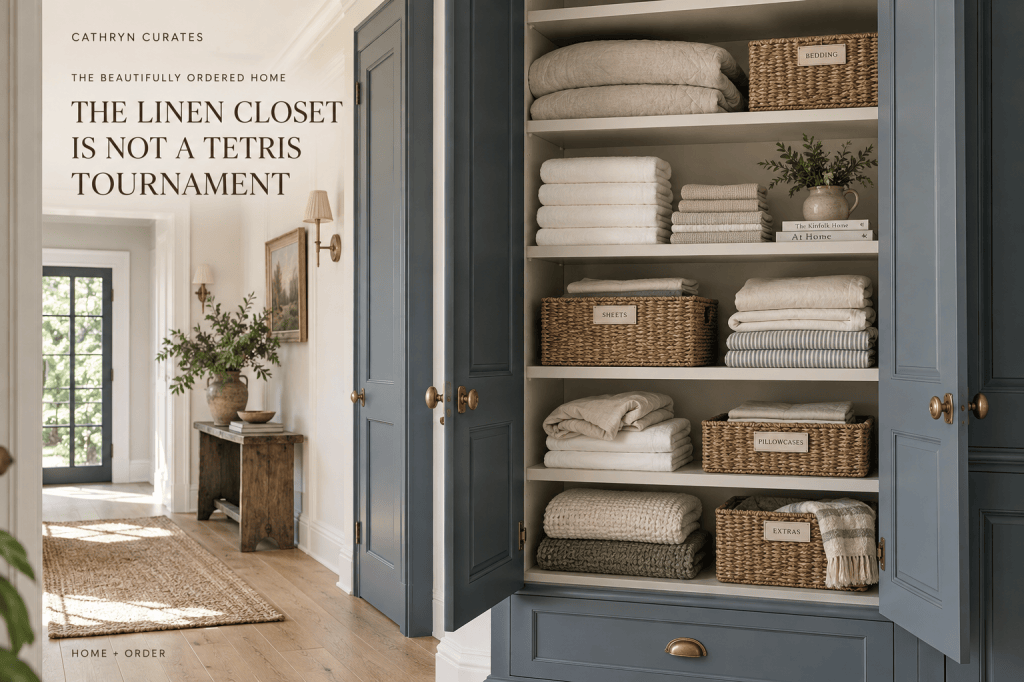
There is a particular kind of household optimism involved in opening an overstuffed linen closet.
You know the move. One hand turns the knob while the other stands ready to catch whatever has spent the last three weeks plotting its escape. A towel slides forward. A fitted sheet loses its nerve. Something vaguely floral falls from the top shelf, and no one is entirely sure whether it belongs to a twin bed, a guest bathroom, or a decade we have collectively agreed to forget.
Then we close the door quickly and call the situation “contained.”
It is not contained. It is merely behind a door.
A beautifully ordered linen closet does not require matching baskets, embroidered labels, or the folding abilities of a luxury-hotel housekeeper. It needs clear limits, sensible placement, and enough breathing room to retrieve one towel without triggering a small textile avalanche.
The goal is not perfection. The goal is a closet that serves the people who live in the house.
Begin With the Life You Actually Live
Before buying bins or practicing increasingly aggressive fitted-sheet folds, consider what the closet needs to hold.
Depending on your household, that may include:
- Bath towels and washcloths
- Bed linens
- Guest linens
- Blankets and quilts
- Table linens
- Extra pillows
- Toiletries
- Paper goods
- Cleaning supplies
- Seasonal bedding
The trouble usually begins when one closet is expected to store all of these categories without limits, zones, or adult supervision.
Start by deciding what genuinely belongs there. A linen closet should not become the honorary residence of every household item currently lacking an address.
The humidifier, travel neck pillow, half-used gift wrap, expired sunscreen, heating pad, and mysterious electrical cord may all be fine objects. That does not mean they belong between the bath towels.
Take Everything Out—Yes, Everything
I realize “remove everything” is standard organizing advice. It is also the step most likely to reveal why the closet no longer works.
When we reorganize around the contents already crammed onto the shelves, we preserve decisions that should have been reconsidered years ago. Emptying the closet gives you a clear view of both the space and the quantity you are asking it to contain.
Place everything into broad categories:
- Keep and use
- Keep elsewhere
- Donate
- Repurpose
- Discard responsibly
This is not the moment to become sentimental about a towel with the absorbency of a dinner napkin.
Keep the linens that fit your current beds, feel pleasant to use, and remain in good condition. Release pieces that are permanently stained, badly worn, uncomfortable, or connected to a mattress size you no longer own.
A home should not be required to provide lifetime storage for every sheet that has ever crossed its threshold.
Decide What “Enough” Looks Like
Most linen closets are not too small. They are simply being asked to hold an undefined amount of everything.
There is no holy household number for towels or sheet sets, but reasonable limits create order. As a starting point, I generally prefer:
- Two complete sheet sets for each regularly used bed
- One or two designated guest sets
- Two bath towels per household member, with a few extras for guests
- A modest supply of washcloths and hand towels
- Seasonal bedding that is genuinely used
- One practical reserve rather than enough inventory to open a small inn
Your household may require more or less. The important thing is to choose the amount intentionally.
If you regularly host overnight guests, keep what allows you to welcome them comfortably. If you have children, pets, allergies, or frequent laundry emergencies, a slightly larger reserve may be entirely sensible.
But “we might need seventeen bath towels someday” is not a household plan. It is a hostage situation involving terrycloth.
Give Every Shelf a Job
Once you know what is staying, divide the closet into zones.
Everyday towels
Place frequently used bath towels, hand towels, and washcloths at an easy-to-reach height. Keep complete categories together rather than scattering matching pieces across multiple shelves.
If the family uses different colors, assign each person or bathroom a color. It reduces confusion and makes it immediately obvious who has been quietly collecting all the good towels.
Bed linens
Store each sheet set together. You can place the folded fitted sheet, flat sheet, and extra pillowcase inside one pillowcase from the set. This keeps the pieces contained without requiring another basket, label, or search party.
Group sets by bed or room—not merely by sheet size.
“Primary bedroom,” “guest room,” and “blue bedroom” are often more useful labels than “queen,” particularly when several beds share the same size.
Guest linens
Create a distinct guest section with fresh sheets, towels, an extra blanket, and perhaps a spare pillow protector.
Hospitality is easier when preparation does not begin with rummaging.
The purpose is not to stage a boutique hotel inside the closet. It is to make welcoming someone feel calm, generous, and manageable.
Seasonal and occasional linens
Place holiday tablecloths, heavy blankets, beach towels, and other occasional items on higher or lower shelves.
These pieces do not deserve the most convenient space simply because they are bulky or arrived first.
Storage should reflect frequency of use. Everyday items get everyday access. Christmas napkins can wait upstairs.
Household supplies
If the linen closet must also hold toiletries, paper goods, or cleaning products, give each category a defined container and limit.
A basket can create useful boundaries, but it cannot perform miracles. If twelve bottles do not fit inside the designated space, the answer is not necessarily a thirteenth basket.
Fold for Function, Not Applause
Uniform folding makes shelves easier to maintain, but no one is awarding points for invisible corners.
Choose a folding method that:
- Fits the depth of the shelf
- Allows items to stack securely
- Makes categories easy to identify
- Can be repeated by the people who actually put away the laundry
That final requirement is important.
A system that only one highly motivated person can execute is not a household system. It is a private performance with increasingly resentful reviews.
Fold towels to the width of the shelf. Keep the folded edge facing outward for a cleaner appearance. Store matching sets together. Use shelf dividers if stacks regularly lean into one another.
And let us release ourselves from the spiritual warfare of the fitted sheet. Fold it neatly enough, place it with its matching pieces, and continue living your life.
Use Containers Selectively
Containers are useful when they solve a specific problem.
They work well for:
- Small toiletries
- Guest supplies
- Cleaning cloths
- Paper products
- Pillowcases
- Seasonal accessories
- Items that otherwise topple or become visually messy
They are less useful when they conceal excessive quantities or consume valuable shelf space.
Before purchasing organizers, measure the closet carefully. Record shelf width, depth, height, door clearance, and any awkward trim or hinges. Attractive baskets that prevent the door from closing are merely decorative obstacles.
Choose a restrained mix of containers rather than forcing every item into a matching bin. Towels and sheet sets often work perfectly well stacked on their own.
We are organizing the linens—not enrolling them in a witness-protection program.
Label for Clarity
Labels should answer the question someone will actually ask while standing in front of the closet.
Useful labels include:
- Primary Bedroom
- Guest Sheets
- Bath Towels
- Hand Towels
- Beach Towels
- Guest Toiletries
- Table Linens
- Extra Paper Goods
Avoid labels so broad that they become meaningless. “Miscellaneous” is not a category. It is a confession.
Clear labels also make it easier for everyone in the household to return things properly. Order should not depend on one person possessing sacred knowledge of where the pillowcases live.
Stop Saving the Best Linens
Many homes contain a small collection of beautiful towels, sheets, or table linens being preserved for an occasion important enough to deserve them.
Meanwhile, the household continues using the scratchy towels and sheets that have developed the texture of printer paper.
Use the good things.
Stewardship is not only preserving what we own. It is using our possessions wisely, caring for them well, and allowing them to serve their intended purpose.
A beautiful home is not created by keeping everything untouched. It is created through daily acts of care—fresh sheets on the bed, a clean towel waiting for a guest, a tablecloth brought out for an ordinary family dinner because the people seated there are reason enough.
Saving the best for “someday” can become another form of clutter.
Create a Five-Minute Maintenance Rhythm
Once the closet is organized, maintaining it should not require another full Saturday.
Once a week:
- Return misplaced items
- Straighten leaning stacks
- Restock frequently used supplies
- Remove empty packaging
- Place incomplete sets with their missing pieces
Once each season:
- Check for worn or damaged linens
- Reassess quantities
- Rotate seasonal bedding
- Donate usable pieces no longer needed
- Confirm that guest supplies are fresh and complete
If the closet becomes crowded again, do not immediately buy another organizer. Revisit the limits.
A container cannot solve a quantity problem. It can only make the quantity problem look more coordinated.
The Beautifully Ordered Standard
A well-organized linen closet should allow you to:
- See what you own
- Reach what you use
- Return items without rearranging the entire shelf
- Prepare a bed or bathroom without searching
- Close the door without negotiation
It does not need to resemble a retail display.
It needs to make daily care easier.
That is the larger purpose of an ordered home. We are not arranging our possessions for the sake of control or appearance. We are creating systems that help us care for our homes, use our resources responsibly, welcome others generously, and move through ordinary life with a little more peace.
So, no—the linen closet is not a Tetris tournament.
There is no prize for fitting one more blanket onto the top shelf. Sometimes the wisest move is not finding a better way to squeeze it in.
Sometimes it is deciding that enough is enough.
Live beautifully. Choose wisely.

