
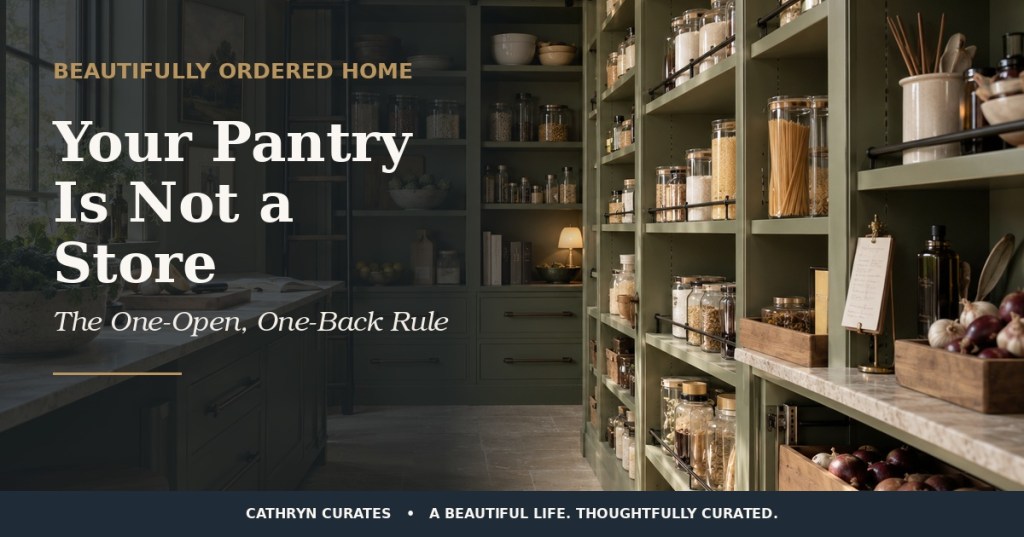
A calmer pantry without turning groceries into décor.
There is a particular kind of domestic absurdity in owning six mustards and still having nothing for dinner.
I know how it happens. One bottle is open. One came in a two-pack. One looked interesting at the market. Two were bought because nobody could remember whether we had any. The sixth has a charming label and the quiet confidence of something that knows it will expire unopened.
This is not a label problem. It is an inventory problem wearing a gingham dress and flip flops.
A beautiful pantry should make it easier to feed people. It should help us see what we have, use it while it is good, and replace it at the sensible moment. It does not need to look like a boutique grocery store with a private equity backer.
The rule I use is simple: one open, one back.
One item is currently in use. One backup may wait patiently behind it, then make its debut when the household reliably finishes that item. When the open item is empty, the backup moves forward and one replacement goes on the list.
Not three. Not six because they were on sale. One. Yep, just one.
The four-zone pantry
This works best when the pantry has four jobs instead of one large category called “things we hope to find again.”
1. Open
The open item belongs where you can see and reach it. If two jars are open, combine them when safe or finish the older one first. Visibility beats a prettier label every time. Sad but true.
2. Backstock
Backstock is for true staples: the olive oil you finish monthly, the coffee your household actually drinks, the pasta that repeatedly becomes dinner.
A backup is not a monument to optimism. It is evidence of a pattern.
If your family uses an item twice a year, it does not need a permanent understudy.
3. Refill
The refill list holds the future so the pantry does not have to. When the backup moves forward, add one replacement to the list. The list remembers. You are released from standing in aisle seven trying to commune spiritually with the ketchup shelf.
4. Use First
Give nearly expired, overbought, or odd little ingredients one visible place. This is not the shelf of shame. It is the shelf of dinner suggestions.
Put one or two items from it into this week’s meals. If you still refuse to use the artisanal lentils after three months of eye contact, admit that the aspiration has passed and make a responsible plan to donate or discard them.
What earns a backup
A backup earns space when four things are true:
- You use the item often.
- Running out would disrupt the household.
- The storage conditions are appropriate.
- You can finish both before quality declines.
Toilet paper? Sensible backup. A seasonal sauce nobody has tasted? That is a first date, not a committed relationship.
Sales do not change this rule. A bargain on something you do not use is not savings; it is prepaid clutter. Buying four to save two dollars is especially unimpressive when two later go into the trash bin.
Please do not begin with containers
This may be controversial in organizing circles, but the first step is NOT ordering forty-seven matching acrylic boxes.
Containers can be useful for flour, rice, sugar, cereal, and other staples when they protect food or make quantities easier to see. But decanting does not create discipline. It can simply hide the fact that you own nine pounds of something your family does not particularly enjoy.
Begin with the pattern. Watch what enters, what gets used, and what lingers. Then buy only the container that solves a proven problem.
Your pantry does not need a costume. It needs a job description.
A Christian note on enough
Scripture teaches us to ask for daily bread, not to build our identity around an impressive private warehouse.
That is not an argument against planning.
The Proverbs 31 woman plans diligently; Joseph stores wisely in preparation for famine. Biblical stewardship is neither careless nor fearful. It pays attention.
The question is not, “How much can I fit?” It is, “What has God entrusted to this household, and how can I use it faithfully?”
Order can serve gratitude. When we see what we have, we waste less. When we stop buying duplicates, we free resources for better purposes. When the pantry supports dinner, it supports hospitality, nourishment, and the ordinary ministry of feeding people.
Contentment is not aesthetic minimalism. It is the quiet ability to recognize enough.
The 15-minute reset
Do this once today:
- Pull forward every open duplicate.
- Choose which one will be finished first.
- Keep one backup only for proven staples.
- Create a small Use First section.
- Start a refill list where the household can reach it.
- Put every extra purchase on trial: Will we use this before it declines?
You do not need a total pantry makeover. You need one honest pass and a rule that survives Tuesday.
Final Thought
A well-ordered pantry is not one with the most containers. It is one that tells the truth: about what your household eats, what it needs, and what is already enough. Let it serve dinner. It does not need to audition for television.
Join the Edit
If you want a home that is beautiful, useful, and thoughtfully curated—not merely full—Join the Edit for one wise household principle, one honest buying judgment, and one gracious nudge each week.

