
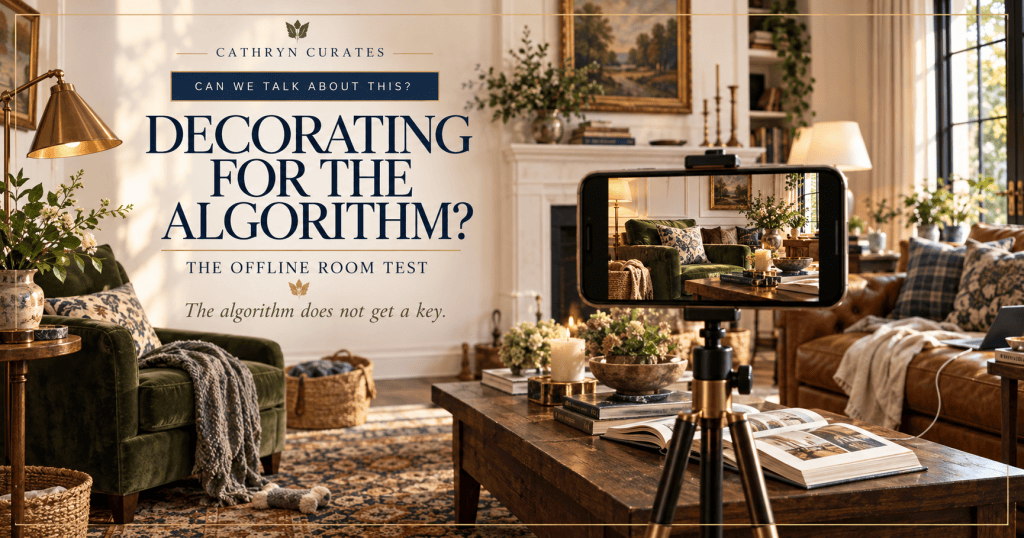
The algorithm is a terrible roommate.
I mean terrible. Take it back to the swamp Shrek!
It never pays the mortgage, empties the dishwasher, or moves its shoes out of the hallway, but it has many opinions about your house.
According to the internet, your kitchen is already the wrong color. Your sofa has lost cultural relevance. Your hardware is either tragically dated or trying too hard. That chair everyone purchased eighteen months ago is now evidence that you possess neither imagination nor a working mood board.
Apparently, the house has embarrassed us, AGAIN!
Can we PLEASE talk about this?
There is nothing wrong with finding inspiration online. I love seeing an inventive color combination, a clever storage solution, or a room that makes me reconsider what is possible. Good design teaches us to notice proportion, texture, craftsmanship, light, and the way a room can support a life.
But when inspiration becomes interference, we begin decorating for the approval of people who will never enter the room.
That is when a home stops being a peaceful place and becomes a phony performance.
When the Camera Becomes the Client
A room designed for a photograph and a room designed for a household are not always the same room.
The photograph wants perfect symmetry, untouched surfaces, flattering light, and perhaps one artfully abandoned book that has clearly never survived an actual reader.
The household needs somewhere to set a glass, charge a phone, store the dog toys, fold a throw, open the mail, and sit down without first requesting permission from the decorative pillows.
Those needs are not design failures. They are the assignment.
A beautifully lived-in home should photograph well because it is thoughtful, not function well only when nothing is happening inside it.
If a room must be reset before anyone is allowed to use it, you have not created beauty. You have hired yourself as an unpaid set dresser.
The Signs That the Algorithm Has Moved In
This is not about owning a popular lamp or liking a trending paint color. Popular things are occasionally popular because they are good.
The problem is not recognition. It is surrender.
The algorithm may be designing the room when:
- You dislike an item you loved last year only because the internet has declared it finished.
- You buy a chair for its silhouette while quietly knowing no human spine wishes to meet it.
- You remove useful objects from sight, then spend every evening retrieving them from inconvenient cabinets.
- You choose finishes for the photograph rather than the maintenance they require.
- You feel compelled to replace a perfectly good room before you can explain what is actually wrong with it.
- You apologize for charging cords, dog beds, family photographs, children’s books, or any other evidence that people live there.
- You can name the room’s aesthetic in three words but cannot describe how it helps your household.
Style is useful. It gives a room direction.
But a label is not a life.
The Real Cost of Trend Performance
Decorating for the algorithm costs more than money.
It costs attention. You begin monitoring your home as though it is a public figure with a fragile reputation.
It costs confidence. Instead of asking whether you like something, you ask whether it is still allowed.
It costs peace. Every new trend creates a fresh category of insufficiency.
And yes, it costs money, because the trend cycle depends on persuading us that a room can become obsolete while the furniture is still in excellent condition.
The internet can make a six-year-old sofa feel like a moral failure. It is upholstery, dear. It has not betrayed the family.
The Offline Room Test
Before buying, replacing, styling, or apologizing for anything in your home, take the room offline.
Imagine that no photograph of it will ever be posted. No guest will silently rank it. No designer will name the decade of the cabinet profile. No stranger will save it to a board.
Then ask these five questions.
1. Would I still choose this if nobody saw it?
This is the preference question.
Remove the social proof, trend label, brand recognition, and possibility of compliments. Is the color, shape, or object still beautiful to you?
There is no prize for achieving someone else’s taste more accurately than your own.
2. Can people use the room without asking permission?
This is the welcome question.
Can someone sit down, put up her feet, open a book, make a cup of tea, or play with the dog without dismantling a vignette?
Beauty that punishes use is merely display.
3. Does it support the household’s real routines?
This is the function question.
Where do keys naturally land? Where does homework happen? Where does the dog sleep? Which chair is chosen every evening? What always needs charging?
Do not design around the routine you wish looked better. Design around the routine that repeatedly occurs.
4. Can I maintain it without resentment?
This is the stewardship-of-energy question.
Every finish, fabric, open shelf, pale rug, sculptural object, and row of decorative pillows eventually sends an invoice payable in time.
You do not need a maintenance-free home. You do need to understand the contract before signing it.
5. Does the room still feel like us when the trend name disappears?
This is the identity question.
If the words organic modern, quiet luxury, coastal grandmother, or whichever phrase arrives next were removed, would the room still contain your history, humor, habits, faith, books, people, and peculiar little preferences?
A room should be recognizable as yours before it is recognizable as a trend.
What Social Media Is Actually Good For
This is not an argument for throwing the phone into the hydrangeas and decorating entirely by instinct.
Online inspiration is useful for:
- Learning design language you were never formally taught.
- Discovering craftspeople, artists, materials, and solutions outside your immediate world.
- Comparing layouts before moving heavy furniture seventeen times.
- Identifying patterns in what consistently attracts you.
- Seeing how other households solve a problem you also have.
The internet should expand your vocabulary, not replace your judgment.
Use it as a reference library, not a landlord.
What I Would Stop Buying for the Photograph
I would pause before buying:
- Seating that looks architectural and feels punitive.
- Open shelving when the household does not enjoy maintaining visual order.
- Pale upholstery selected for the feed despite the presence of children, pets, red wine, or ordinary gravity.
- Decorative objects purchased in sets to manufacture the appearance of collecting.
- Microtrend finishes applied to expensive permanent surfaces.
- Storage pieces too small to store the thing but sufficiently charming to conceal that fact until the return window closes.
I would spend instead on what survives the Offline Room Test: comfortable seating, good lighting, durable textiles, useful tables, meaningful art, appropriate storage, and pieces whose beauty becomes clearer through use.
That is not less stylish.
It is style with a job.
A Christian Note on the Quiet Life
Scripture gives us a useful question about the audience we are trying to satisfy. Paul writes, “For do I now persuade men, or God? or do I seek to please men? for if I yet pleased men, I should not be the servant of Christ” (Galatians 1:10, KJV).
That verse is not an interior-design rule, of course. But its principle reaches uncomfortably well into a home shaped by public approval. We should notice when the desire to be seen as tasteful, current, successful, or enviable begins governing choices that no longer serve the people God has actually entrusted to us.
Paul also urges believers “that ye study to be quiet, and to do your own business, and to work with your own hands” (1 Thessalonians 4:11, KJV). There is something deeply countercultural in building a quiet, faithful life that does not require constant public confirmation.
And when the home welcomes others, Scripture says, “Use hospitality one to another without grudging” (1 Peter 4:9, KJV). Hospitality is not a performance of perfection. It is a willing welcome. The guest does not need a trend-compliant room nearly as much as she needs somewhere she can exhale.
The Christian aim is not to make the home unattractive or anonymous. Beauty can reflect creativity, gratitude, care, and order. But beauty is a servant, not a master; a gift, not an identity; and a setting for love, not evidence presented to an audience.
The camera may admire the room.
God is concerned with what happens inside it.
The Verdict
Keep the inspiration. Keep the excellent ideas. Keep the color you discovered online and genuinely love.
But evict the imaginary audience.
Your home does not need to prove that you understand the moment. It needs to hold the life you are living—with sufficient grace for cords, cups, dog toys, difficult Tuesdays, and people who would rather sit comfortably than admire the chair from a respectful distance.
The algorithm can suggest.
It does not get a key.
Final Thought
If the room only works when nobody is living in it, the room does not work.
Join the Edit
For candid conversations about beautiful homes, useful rooms, thoughtful purchases, and the occasional trend that needs to be sent home with its things, Join the Edit.
We are making fewer, better, more beautiful choices and designing for the lives we actually live.

