
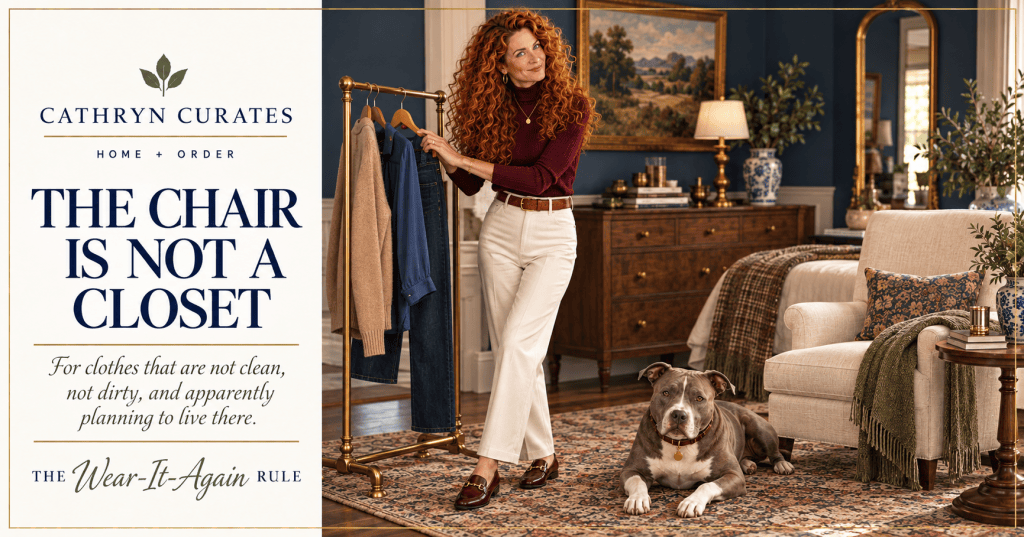
There is a chair in the bedroom that has not been available for sitting since approximately February.
It began innocently.
One sweater was worn for two hours and did not deserve the indignity of the laundry basket. A pair of jeans was still perfectly respectable. Then came the cardigan, the church dress, the workout jacket worn mostly in the car, and a blouse requiring emotional preparation before anyone could decide whether it needed dry cleaning.
The chair did not volunteer for this position.
Nevertheless, it has become middle management for undecided clothing.
We call it clutter, but that is not quite accurate. The chair is holding items that have no official destination because our closets usually recognize only two categories:
Clean enough to put away.
Dirty enough to wash.
Real life has a third category:
Worn, still wearable, and currently avoiding a decision.
That category needs a home.
The Wear-It-Again Rule
Here is this week’s principle:
If you intend to wear it again, give it one visible, limited place—and one week to earn the second wear.
The system has two essential parts:
- One designated Wear-It-Again location
- A firm capacity limit
Your designated location might be:
- Three hooks inside the closet
- A short valet rail
- One section of an open hanging rack
- A single attractive basket for folded knitwear
- One hanger marked WEAR AGAIN
The specific object matters less than the boundary.
When that space is full, something must be worn, washed, returned to the closet, or released.
We are not building an annex.
Why the Chair Keeps Winning
The chair is convenient.
It requires no hanger, no folding, no decision, and no meaningful relationship with a closet door. You can remove a sweater and place it there in one fluid motion while telling yourself you will handle it later.
Later, unfortunately, has terrible follow-through.
By Thursday, the chair is covered, the clothing at the bottom is wrinkled, and you no longer remember which blouse was worn for lunch and which one survived an entire airport.
The pile becomes visually noisy and practically useless.
You cannot see what is available to rewear, so you choose something clean. The undecided clothes remain untouched. Eventually, everything enters the laundry—not because it is dirty, but because washing it feels easier than sorting it.
That costs time, water, energy, and unnecessary wear on the clothes themselves.
The chair is not the problem.
The missing decision is.
A Christian Note on Order Without Obsession
Scripture says:
“Let all things be done decently and in order.” — 1 Corinthians 14:40, KJV
Paul was addressing orderly worship, not issuing divine instructions about cardigans. We should not flatten Scripture into a storage manual.
But the principle still reveals something important about God’s character: order serves purpose.
Biblical order is not sterile perfection. It is not a house in which no one moves, touches anything, or owns a sweater.
Order removes needless confusion so that people can live, serve, rest, and respond faithfully.
The goal is not to make the bedroom worthy of inspection. The goal is to stop allowing small, unresolved decisions to consume attention every time we enter the room.
Good order supports peace.
It does not demand worship.
We are managing the clothing. The clothing is not managing us.
Decide What “Wear Again” Actually Means
Not every garment qualifies.
An item belongs in the Wear-It-Again area only if:
- It is visibly clean
- It smells fresh
- It held its shape
- It is appropriate to wear again without laundering
- You genuinely expect to wear it within seven days
If the item is stained, stretched, sweaty, smoky, or carrying enough perfume to introduce itself before you enter the room, it goes to the laundry.
If it is clean enough to store and you are not planning to wear it soon, return it to the closet.
If you keep removing it, considering it, and choosing something else, the issue may not be cleanliness.
You may simply not like it.
That is useful information.
The Five-Minute Monday Chair Reset
Set a timer for five minutes.
We are resolving clothing decisions, not reorganizing the entire wardrobe while standing in yesterday’s earrings.
Step 1: Empty the chair completely
Remove every garment.
The chair needs to become a chair again before your brain will stop treating it as legitimate storage.
Step 2: Sort into four decisions
Create four categories:
- Wear again
- Wash
- Put away
- Release
Do not create a fifth category called I will think about it while returning everything to the chair.
We have met that system. It lacks leadership.
Step 3: Inspect the Wear-Again items
Give each item an honest thirty-second assessment.
Look at the collar, cuffs, underarms, knees, and seat. Check for marks, odor, wrinkles, and loss of shape.
This is garment stewardship, not wishful thinking.
Step 4: Place approved items in their designated zone
Use your hooks, valet rail, basket, or marked hanger.
Keep the area visible. Wear-again clothing hidden inside a decorative box will become a textile time capsule.
Step 5: Restore the chair
Add one pillow, a folded throw, or nothing at all.
Then sit in it.
This is important. A chair regularly used by a human is less likely to be annexed by denim.
The Seven-Day Decision
Wear-again clothes do not receive indefinite residency.
Give them seven days.
At the end of the week:
- Wear the item
- Wash it
- Return it to proper storage
- Admit that you are avoiding it
This limit prevents the Wear-It-Again area from becoming a smaller, more official-looking version of the original pile.
Labels do not create order when the underlying decision remains unresolved.
They simply give indecision a monogram.
Before You Buy a Garment Rack
Please test the behavior before buying the equipment.
Use three existing hangers, temporary hooks, or a small cleared section of the closet for two weeks.
Notice what you actually place there:
- Do you hang blouses but fold sweaters?
- Do jeans need a rail rather than a hook?
- Does your spouse require a separate section?
- Is the real problem clothing—or the fact that your closet is already full?
Once the pattern is clear, you can choose the right solution.
A slim valet rail may be worth buying if it fits the room, holds the correct number of garments, and prevents daily pileup.
A twelve-foot open garment rack may be less of a solution and more of a retail expansion.
The Edit begins with judgment.
We buy the tool after we understand the problem.
The Closet May Be Telling on You
Sometimes the chair pile is not caused by missing hooks.
It is caused by a closet so crowded that returning one blouse requires negotiation.
If putting away clean clothes feels disproportionately difficult, examine the storage around them.
Can hangers move freely?
Can drawers close without physical persuasion?
Can you see what you own?
Are you preserving clothes for a former size, former job, former climate, or former version of yourself who apparently attended six cocktail parties a week?
The chair may be the overflow valve.
In that case, do not merely relocate the pile. Reduce the pressure.
Make the System Beautiful Enough to Maintain
Beauty matters because we are more likely to maintain systems that feel integrated into the room.
Choose hooks that complement the hardware. Use a wooden hanger rather than a wire one. Select a shallow woven basket rather than a plastic hamper if the items need to breathe.
But beauty must serve function.
The prettiest basket in the world is still a failure if it swallows ten sweaters and requires excavation.
A successful Wear-It-Again zone should be:
- Easy to reach
- Easy to see
- Limited in capacity
- Appropriate for the garments
- Visually quiet when partially full
That is enough.
Join the Edit
If you are ready for a home with better systems, fewer repeat purchases, and significantly less furniture performing unauthorized side work, Join the Edit.
You will receive thoughtful home guidance, honest buying judgment, and curated finds that earn their place.
Tell me in the comments: Which piece of furniture in your home currently has a job it was never hired to do?
Final Thought
The goal is not a bedroom that never contains a stray sweater.
The goal is a room in which one sweater does not become an ecosystem.
Give wear-again clothes one place, one limit, and one week.
Then return the chair to its original calling which is holding you.

