
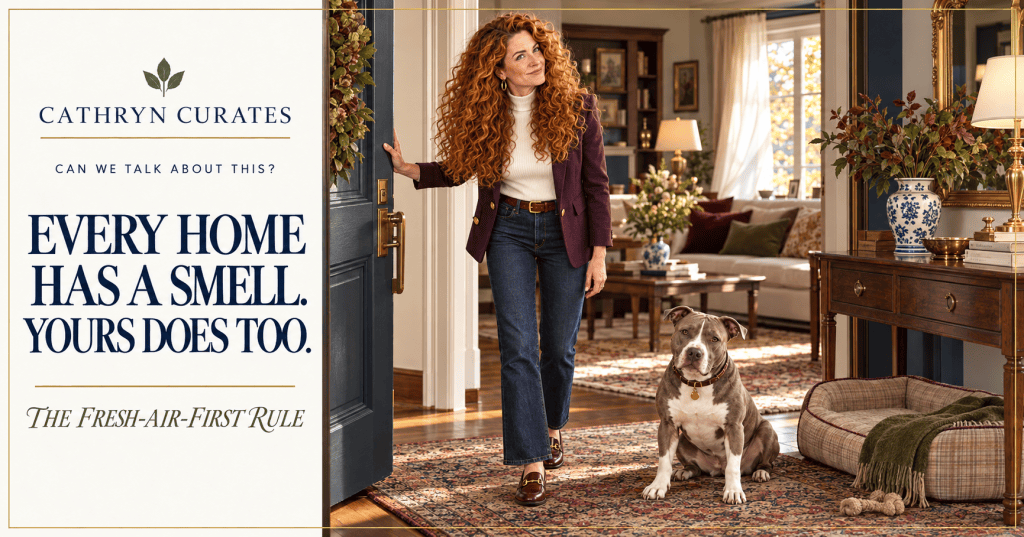
Every Home Has a Smell. Yours Does Too.
Before you light another candle, open the window and investigate.
Can we talk about the way your house smells?
Not someone else’s house. Yours.
Every home has a scent. Some greet you with coffee, polished wood, laundry, and the faint possibility that someone has recently baked something civilized.
Others introduce themselves with last night’s salmon, a damp bath towel, three competing plug-ins, and a dog who has retained legal counsel.
The difficult part is that the people who live in the house are frequently the least qualified to smell it.
We adjust. Our brains stop treating a familiar background odor as new information. We walk through the front door and smell nothing at all, while a guest receives the complete household biography before removing her coat.
This is commonly called nose-blindness. It is not a character flaw. It is sensory adaptation.
But it does mean your nose may have quietly recused itself from the investigation.
The Fresh-Air-First Rule
Here is today’s principle:
Remove the source. Clean the textile. Empty the bin. Open the window. Fragrance comes last.
Fragrance should finish a clean room—not negotiate a settlement with an odor.
A candle cannot wash a dog bed. A plug-in cannot unclog a drain. A reed diffuser cannot persuade a damp towel to reconsider its choices.
And “Autumn Orchard Bourbon Vanilla” layered over garlic, wet fur, and yesterday’s trash does not create a signature scent.
It creates a custody dispute or even worse a battle!
Before adding anything scented, deal honestly with what is already in the air.
First, Leave the House
The best way to smell your home more accurately is to interrupt your familiarity with it.
Go outside for thirty minutes. Take a walk. Run an errand. Sit on the porch and pretend you are not checking your phone.
Then return through the entrance your guests actually use.
Do not light a candle first. Do not spray anything. Do not ask the family for reassurance; they are part of the same compromised jury pool.
Walk in and notice the first ten seconds.
Does the house smell:
- Stale or closed?
- Damp?
- Heavily perfumed?
- Like cooking oil or yesterday’s dinner?
- Like pets, even if the pets are wonderful and emotionally indispensable?
- Like laundry that dried slowly?
- Like nothing in particular, which is an entirely respectable outcome?
You are not trying to make your home smell like a luxury hotel lobby has married a cider mill.
You are trying to find out whether the air feels clean, neutral, and welcoming.
The Usual Suspects
Most persistent household odors are not mysterious. They are simply hiding in materials we have stopped noticing.
Upholstery and rugs
Fabric absorbs life.
Sofas collect body oils, pet smells, food, dust, and whatever happened during movie night. Rugs receive shoes, paws, spills, humidity, and the occasional event everyone has agreed not to discuss.
Vacuum slowly, including beneath cushions. Follow the manufacturer’s cleaning instructions. Wash removable covers when permitted. Have rugs and upholstery professionally cleaned when ordinary maintenance is no longer winning the argument.
Spraying fabric refresher over an unclean textile may improve the opening statement.
It does not change the evidence.
Pet beds, blankets, and toys
Your pet may smell delightful to you because love has powerful editing privileges.
His bed may not.
Wash washable covers and blankets on a regular rhythm. Vacuum the cushion and surrounding floor. Clean soft toys according to their care instructions, and retire anything that has reached the archaeological stage.
This is not anti-dog. The dog remains perfect.
His blanket, however, has made some choices.
Kitchen grease and food
Cooking odors do not always leave when dinner does.
Grease settles on range hoods, cabinet fronts, backsplashes, nearby textiles, and the top of the refrigerator—the domestic continent few people visit willingly.
Clean the range hood and filter according to the manufacturer’s instructions. Empty food waste promptly. Wash the kitchen bin. Check the garbage disposal and sink drain. Launder the dish towels before they begin expressing themselves from across the room.
Ventilate while cooking whenever possible.
Moisture
A musty smell is not a fragrance problem. It is a moisture question.
Look for damp towels, shower curtains, bath mats, slow leaks, wet basements, overwatered plants, clogged drains, and laundry left in the washing machine long enough to develop voting rights.
Persistent mustiness, visible mold, or unexplained moisture deserves proper investigation—not a eucalyptus candle placed nearby in a position of symbolic authority.
Bins, drains, and hidden corners
Sometimes the grand mystery is a potato.
Check pantry baskets, produce drawers, trash and recycling bins, sink drains, diaper containers, laundry hampers, the vacuum cleaner, and the mysterious territory beneath large appliances.
Also check shoes.
I will offer no further commentary at this time.
Clean Does Not Have to Smell Like Anything
This may be controversial, but “clean” is not a fragrance family.
A clean home may smell faintly of open air, wood, soap, coffee, dinner, or nothing particularly identifiable. It does not need to announce “linen breeze” from the driveway.
Strong scent can create the impression of cleanliness, but impression and condition are not the same thing.
This is especially important when multiple scented products are operating simultaneously:
- Scented detergent
- Fabric softener
- Floor cleaner
- Counter spray
- Plug-ins
- Candles
- Wax melts
- Room spray
- Diffusers
- Scent beads apparently engineered to survive the millennium
Individually, each may be pleasant. Together, they can turn the house into a department-store fragrance counter during an electrical emergency.
Choose restraint.
If You Love Fragrance, Give It a Point of View
I enjoy a beautiful candle. This is not a campaign against bergamot.
Once the house is genuinely fresh, fragrance can contribute atmosphere. The key is to let it support the home rather than occupy it.
Choose one general scent direction at a time:
- Woods and amber
- Citrus and herbs
- Soft florals
- Tea and spice
- Clean, restrained linen notes
- Seasonal greenery
Do not make every room audition a different personality.
If the foyer is sandalwood, the living room is pumpkin chai, the powder room is ocean mist, and the kitchen is lemon verbena, the house is not layered.
It is speed dating.
Use less than you think you need. Allow unscented rooms between fragranced spaces. And remember that your preferred intensity has been calibrated by a nose already living there.
The Guest-Nose Standard
Hospitality requires us to consider what another person experiences, not merely what we have become accustomed to.
Some guests are sensitive to strong fragrance. The American Lung Association notes that fragranced products can cause irritation or trigger symptoms for some people, particularly those with asthma, allergies, migraines, COPD, or chemical sensitivities. The EPA also explains that inadequate ventilation can increase indoor pollutant levels. lung.org
That does not require panic or a banishment ceremony for every candle you own.
It does suggest wisdom:
- Avoid heavily scenting the guest room.
- Skip plug-ins in small enclosed spaces.
- Do not spray fragrance immediately before company arrives.
- Ventilate after cooking and cleaning.
- Ask overnight guests about sensitivities.
- Keep at least some household and laundry products fragrance-free.
A guest should not need an inhaler and a backstory to survive the powder room.
A Christian Note on Attentive Hospitality
Paul’s instruction in Romans 12 includes this practical charge:
“Distributing to the necessity of saints; given to hospitality.” — Romans 12:13, KJV
Romans 12 describes what a life transformed by God’s mercy looks like in relationship with other people: sincere love, service, generosity, patience, prayer, and hospitality.
Yes, this verse is not about fragrance.
But it is about attentiveness.
Biblical hospitality is not domestic performance. It is not proving that our houses are impressive, expensive, perfectly arranged, or scented according to the season.
It is making room for people and considering their needs.
Sometimes that looks like a beautiful meal and a freshly made bed. Sometimes it looks like turning off the plug-in, opening a window, washing the dog blanket, and caring whether a guest can breathe comfortably in the room.
Welcome is not what we intend people to experience.
It is what they actually experience when they arrive.
The Cathryn Curates Home-Scent Audit
Once a week, give the house ten honest minutes:
- Empty kitchen and bathroom bins.
- Check towels, bath mats, and laundry.
- Wash or air the pet bedding.
- Inspect drains and the garbage disposal.
- Ventilate the kitchen and main living area.
- Vacuum rugs and upholstered seating.
- Smell the house before adding fragrance.
Then—and only then—decide whether the room needs a candle.
It may.
But now the candle is providing atmosphere rather than witness protection.
The Cathryn Curates Verdict
Your home does not need to smell expensive.
It needs to smell cared for.
That means clean textiles, managed moisture, emptied bins, ventilated rooms, a little honesty about the dog bed, and fragrance used with restraint.
The goal is not a house without any scent. Homes contain people, meals, books, wood, laundry, pets, flowers, and life. They should not smell chemically erased.
Let the house smell quietly alive.
Just make sure last Tuesday’s broccoli is no longer participating.
Join the Edit
What scent immediately tells you that you are in someone else’s home and what household smell are you secretly afraid you have stopped noticing in yours?
Tell me in the comments. Then leave the house for thirty minutes, return through the front door, and conduct the Guest-Nose Test before lighting anything.
For thoughtful home guidance, honest buying judgment, useful systems, and the occasional truth nobody requested about the dog blanket, Join the Edit.
Final Thought
A welcoming home does not need to smell like a candle catalog.
It should smell clean enough to exhale, familiar enough to feel human, and gentle enough to make room for the person walking through the door.
Fresh air first.
Fragrance last.

