
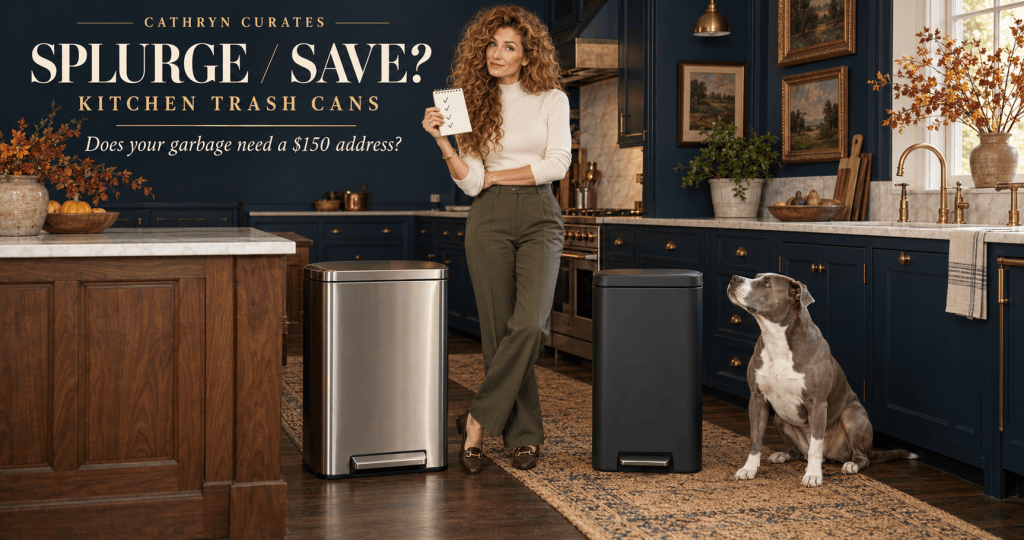
There are objects we buy because they are beautiful, objects we buy because they are useful, and objects we buy because the old one has begun making a noise that feels personal.
The kitchen trash can can be all three.
Once upon a time, a bin was a plastic cylinder placed under the sink. Now it may arrive in brushed stainless steel with a silent-close lid, custom-liner dispensing system, fingerprint resistance, odor pods, dual compartments, voice control, and a price that suggests it has completed graduate school.
So, is the expensive one worth it?
Sometimes.
But your garbage does not become more refined because it enters a $150 container. The splurge earns its price only when the can improves a problem you encounter repeatedly.
Welcome to Splurge / Save, where the third option is always allowed into the room:
Keep the perfectly functional thing you already own.
The New Principle: The Daily Friction Dividend
Spend more only when a product improves a task you repeat every day.
A beautiful finish is pleasant. A reliable pedal, secure liner, quiet lid, cleanable interior, sensible capacity, and shape that fits the room are useful.
The more often you interact with an object, the more valuable small improvements can become. That is the Daily Friction Dividend.
If you open a kitchen bin twenty times a day, a sturdy pedal and lid that closes properly can matter. If your current can lives inside a cabinet and causes no trouble, replacing it with a stainless-steel monument is not an upgrade.
It is a transfer of funds.
Before You Shop
This article contains Amazon affiliate links. As an Amazon Associate, I earn from qualifying purchases. I recommend only products I would genuinely consider for the use described. Your price is not increased by using these links.
Prices, sellers, colors, specifications, and availability may change. Please confirm the current listing before purchasing.
The Splurge
Simplehuman 45-Liter Rectangular Step Can
Suggested Amazon product: Simplehuman 45-liter rectangular step can
This is the polished candidate: a rectangular stainless-steel body, steel pedal, slow-closing lid, liner rim, and built-in pocket for dispensing custom-fit liners.
The company currently advertises a ten-year warranty for this 45-liter model. The listing describes a pedal engineered for more than 150,000 steps and a rim designed to conceal and secure the liner.
Those features matter more than the fact that the stainless steel looks handsome beside the cabinetry.
What the splurge buys
- A strong, frequently used foot pedal.
- A controlled lid that does not slam during midnight cleanup.
- A liner rim that hides the bag instead of displaying it like a ruffled petticoat.
- Onboard liner storage.
- A stable rectangular footprint.
- A longer published warranty than many inexpensive alternatives.
- A finish appropriate for an open kitchen where the can remains visible.
What the splurge does not buy
- Immunity from fingerprints.
- Freedom from cleaning.
- Miraculous odor elimination.
- Permission to postpone taking out the trash.
- Complimentary therapy when someone installs the liner incorrectly.
There is also an ongoing-cost question. The proprietary liners fit neatly, but they cost more than ordinary tall-kitchen bags. Standard bags may work, but the polished, hidden fit is part of what the premium design is selling.
If you resent buying special liners, do not ignore that feeling.
It will not become more charming on the fourth reorder.
The Save
Rubbermaid 13-Gallon Step-On Kitchen Trash Can
Suggested Amazon product: Rubbermaid 13-gallon step-on trash can
The save option is straightforward: a dark body, hands-free pedal, lidded design, practical capacity, and compatibility with common 13-gallon bags.
It is not trying to become kitchen sculpture.
It is trying to receive a coffee filter without requiring your hand to touch the lid.
That is honorable work.
What the save gets right
- Familiar bag size.
- Hands-free foot-pedal operation.
- Dark finish that disguises ordinary wear.
- Lower replacement cost.
- Simple construction with fewer premium systems to justify.
- A sensible choice for a pantry, utility room, apartment, or concealed placement.
Where the save may feel like a save
The pedal, hinges, lid movement, liner retention, finish, and long-term stability may not feel as substantial as a premium model. Plastic can also hold odors or show wear differently from stainless steel.
None of those limitations automatically makes it a bad purchase. They simply mean the decision should be based on where the can lives and how hard your household uses it.
The Five Tests That Actually Matter
1. The Location Test
Is the can exposed in an open kitchen, or hidden in a pantry or cabinet?
If it is visible from the living room, appearance carries some legitimate value. If it lives behind a door, paying primarily for a polished exterior is like wearing formal shoes to reorganize the attic.
2. The Household Test
How many people use it? Are there children, pets, frequent cooks, or several daily meals at home?
A heavily used pedal and lid justify more attention to durability. A one-person household that empties the bin twice a week may not receive the same return.
3. The Gross-Moment Test
Can you clean the rim, hinge, interior, and surrounding crevices without requiring specialized tools and emotional preparation?
The best trash can is not the one that looks pristine in the product photograph.
It is the one you can restore after the bottom of the bag introduces itself to the floor.
4. The Liner Test
Does the bag stay up? Is it hidden? Can you remove it without wrestling suction? Must you buy a proprietary size?
A liner that collapses into the can every afternoon is daily friction. A small annoyance repeated hundreds of times becomes a real design problem.
5. The Pet Test
Will the lid deter your particular animal?
Our dog may be perfect, but he remains interested in kitchen developments. A stable can with a reliably closed lid matters in a pet household.
Motion-sensor lids can be convenient, but clever pets and accidental openings may turn convenience into dinner theater.
My Verdict
Splurge if:
- The can is visible in an open kitchen.
- Your household uses it constantly.
- Weak pedals and slipping liners have already irritated you.
- Quiet closing and a stable footprint matter.
- You will keep the can long enough for its cost per use to become reasonable.
- You are comfortable with the liner system and its ongoing cost.
Save if:
- The can is concealed.
- Standard bags matter more than a perfectly hidden liner.
- Your household produces modest trash volume.
- You prefer simple construction.
- You can replace the save option several times before reaching the premium price.
- Your current can already works without daily aggravation.
The Cathryn Curates call
For a high-use, open kitchen, I would splurge on a well-built step can, but, I would choose the mechanical pedal model over unnecessary electronics.
For a pantry, utility room, rental, office, or lighter-use household, I would save.
And if the can you own opens, closes, holds the bag, contains the mess, and has not declared war on your shin, I would keep it.
Not every ordinary object needs a luxury conversion.
A Christian Note on Wisdom and the Whole Cost
“Through wisdom is an house builded; and by understanding it is established:”
—Proverbs 24:3 KJV
This proverb is not a command to purchase superior household accessories. It teaches that a sound household is established through wisdom and understanding—not appearance alone.
Wise stewardship considers the whole cost: the purchase price, replacement liners, maintenance, durability, actual need, and whether the product meaningfully serves the household entrusted to us.
Sometimes wisdom buys the better tool because it will be used for years.
Sometimes wisdom keeps the ordinary tool because it already performs its work.
Discernment is not automatically found in the expensive aisle or the bargain aisle. It is found in understanding what the household actually needs and refusing to let marketing make the decision on our behalf.
Join the Edit
What is the most ridiculous amount you have considered spending on an aggressively ordinary household object?
Tell me in the comments. Confession is good for the soul, and apparently very good for the home-goods industry.
Join The Edit for beautiful spaces, worthwhile finds, practical order, Christian thought, and honest buying judgment because your home should serve your life, not become its most demanding dependent.
Final Thought
The question is not whether a premium trash can is absurd.
In isolation, it absolutely is.
It holds garbage.
The better question is whether its construction removes enough repeated annoyance to earn its cost in your particular home.
If it does, splurge thoughtfully.
If it does not, save cheerfully.
And if your current can is behaving itself, close the shopping tab.
You have already won.

