
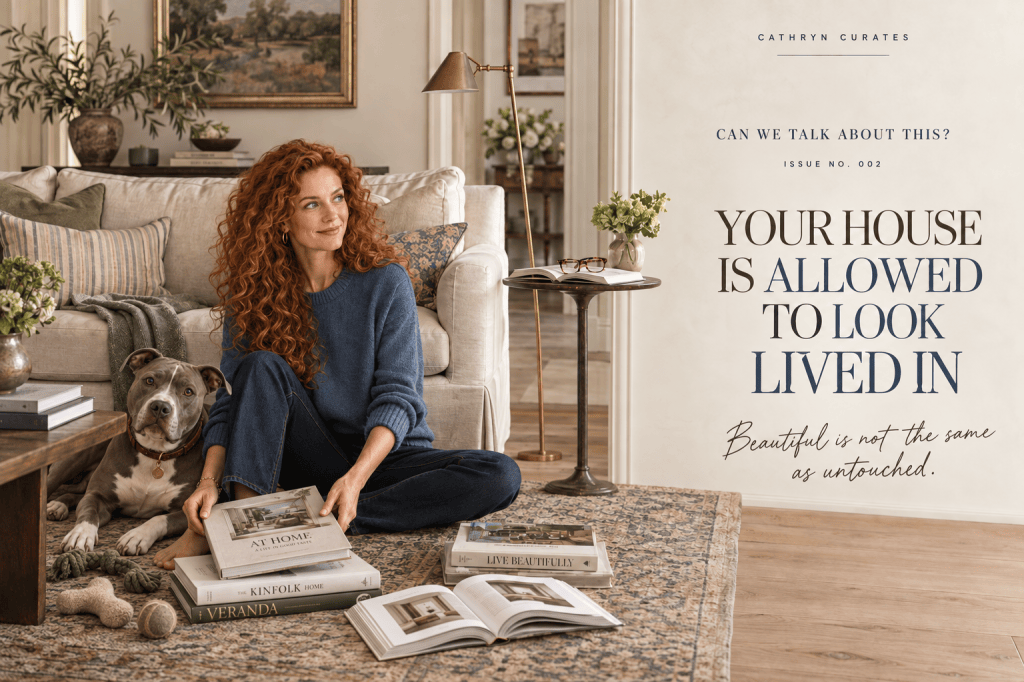
Can we talk about this?
At some point, “a beautiful home” became suspiciously close to “a home in which no one appears to live.”
The pillows are standing at attention. The countertops are completely empty. The books have never been opened. The throw is draped with such mathematical precision that using it would feel like vandalism.
No mail. No shoes. No keys. No Backpacks. No open computers sitting on the couch. No evidence that anyone has prayed, eaten, rested, laughed, worked, hosted, hurried out the door, or returned home tired.
Just a lovely room waiting for a life to begin.
I am guilty. I adore a beautifully arranged home. I believe order matters, thoughtful details make daily life better, easier, and caring for our surroundings is a worthwhile form of stewardship of the things God has gifted us.
But a home is not failing because someone left a book open.
It is not ruined because a blanket has been used.
And it does not need to look untouched to be beautiful.
A Cared-for Home Is Not the Same as a Perfect Home
There is a meaningful difference between a home that is lived in and one that is neglected.
“Lived in” does NOT mean dirty dishes developing their own ecosystem or laundry becoming a permanent floor covering. It does not mean abandoning every useful routine and declaring the resulting chaos authentic.
That is not freedom. That is Tuesday getting away from us.
A cared-for home can still contain signs of life:
- A book beside the chair where someone reads
- A blanket softened by regular use
- Shoes near the door during the busy part of the day
- A board game waiting to be finished
- A child’s artwork on the counter
- A dog toy beneath an otherwise lovely table
- A kitchen showing evidence that dinner happened
- A stack of mail awaiting its scheduled reset
The distinction is not whether anything is out of place.
The distinction is whether the room can return to order without requiring a rescue operation. (This part!)
The Internet Has Distorted the Standard
Most photographs of beautiful interiors are not photographs of ordinary life. They are photographs of rooms prepared for photography.
Cords are removed. Personal belongings disappear. Furniture is adjusted. Pillows are arranged. Surfaces are cleared. Lighting is controlled. Someone may even bring in flowers that do not normally live there.
There is nothing wrong with that. Styling helps us see the architecture, furniture, colors, and details clearly.
The trouble begins when we compare our actively inhabited homes to images of rooms that were temporarily relieved of their inhabitants.
A professionally styled photograph is a moment and is not a reasonable full-time household standard.
Your home does not need to remain camera-ready while you are living in it.
People Are Not Interruptions to the Design
The purpose of a home is not to preserve the arrangement of the furniture.
It is to shelter, restore, welcome, nourish, and support the people entrusted to it.
The sofa is there to be sat upon. The table is there to gather around. The towels should dry actual people. The dishes should serve food. The beautiful blanket should warm someone who is cold.
When protecting the appearance of a room becomes more important than allowing people to use it comfortably, the design has stopped serving the household.
People are not intrusions into the home.
They are the reason for it.
A beautiful home should invite someone to sit down—not make them wonder which chair is safe.
Sometimes Perfection Is Just Control in Better Lighting
Get ready because here comes the spicy.
Sometimes our desire for a perfectly arranged home is not entirely about beauty. Sometimes it is an attempt to create visible control when life feels uncertain elsewhere.
Um, Ouch!
If every counter is clear, every pillow is positioned, and every drawer is disciplined, perhaps we can feel as though everything is fine.
Order can absolutely support peace. Good household systems reduce frustration, preserve time, and make daily responsibilities easier.
But order stops being helpful when it makes everyone afraid to disturb the room.
Saying that louder for the folks in the back!
IF THE PEOPLE IN THE HOUSE FEEL AS THOUGHT THEY ARE CONSTANTLY FAILING THE HOUSE, THE STANDARD MAY NEED RECONSIDERATION.
Peace is not produced by maintaining a home no one can comfortably use.
Just sayin’.
Let the Room Tell the Truth
A thoughtfully designed room should reflect the way it is genuinely used.
If you read in the living room, give your books an attractive, accessible place rather than pretending books never enter the room.
If your family removes shoes at the door, provide a tray, basket, cabinet, or bench that supports that habit.
If blankets migrate around the house, place a generous basket near the seating area.
If paperwork regularly lands on the kitchen counter, create a defined location and a consistent time to process it.
Good design does not deny behavior. It anticipates it.
The answer is rarely to demand that everyone stop living naturally. The better answer is usually to give recurring activities a graceful place to happen.
Beautiful Storage Should Support Use
Not everything needs to be displayed, but not everything needs to be hidden, either.
Keep frequently used objects close to where they are used. Choose storage that makes returning them simple:
- A tray for daily essentials
- A basket for throws
- A drawer for charging cords
- A cabinet for games
- A bowl for keys
- A magazine holder for current reading
- A designated place for incoming mail
- A small bin for pet toys
The container should serve the habit.
If putting something away requires opening three boxes, removing a lid, shifting another object, and making a small ceremonial offering, the system will not survive an ordinary Wednesday.
Convenience is not laziness. It is intelligent design.
Leave Some Surfaces Available for Life
A beautiful surface does not need to be completely empty, but it should have enough room to perform its actual purpose.
A dining table can hold a bowl or arrangement while still leaving room for dinner. A coffee table can display books while allowing someone to set down a glass. A kitchen counter can be attractive without hosting seventeen decorative objects between the sink and the cutting board.
Editing matters because empty space creates flexibility.
Not every corner needs decoration. Sometimes the most luxurious thing in a room is enough open space to use it comfortably.
Before adding another decorative object, ask whether the room needs more styling—or simply more room.
Establish Reset Points Instead of Demanding Constant Perfection
A home can be orderly without being continuously reset.
Choose natural transition points for returning rooms to order:
- After breakfast
- Before leaving for work
- At the end of the workday
- After dinner
- Before bed
- During the Sunday reset
A five- or ten-minute evening reset can restore the living room, clear the kitchen counter, gather stray objects, and prepare the home for the next morning.
This allows the house to be used freely during the day without remaining in permanent disorder.
The goal is not to follow everyone around fluffing pillows behind them.
That is not a household rhythm. That is an exhausting hobby.
Use the Beautiful Things
Homes often contain items considered too special for ordinary use:
- The good dishes
- The beautiful towels
- The linen napkins
- The inherited serving bowl
- The guest-room blanket
- The candle being saved for an undefined future occasion
Use them thoughtfully.
Stewardship does not mean keeping everything untouched until it eventually passes to someone who has no idea why it was important. Caring for what we own includes allowing useful things to fulfill their purpose.
An ordinary dinner with people you love is an occasion.
A quiet evening at home is an occasion.
A friend stopping by is an occasion.
Tuesday is allowed to have the good napkins.
Hospitality Is About Welcome, Not Inspection
When someone enters your home, they are far more likely to remember how they felt than whether the coffee table had exactly three objects on it.
Did they feel comfortable?
Were they invited to sit down?
Could they exhale?
Did the home feel generous, peaceful, and genuine?
Hospitality is not a performance of perfection. It is the practice of making room for another person.
That does not require an immaculate house. It requires a welcoming heart and enough practical order that hosting does not send the household into emotional bankruptcy.
There is a quiet spiritual distinction here. We care for our homes because they are places of provision, rest, service, and relationship—not because flawless rooms prove our worth.
The home is a gift to steward, not a stage upon which to prove ourselves.
The Standard Is Cared For, Not Untouched
A beautiful, lived-in home usually has a rhythm.
It becomes untidy. It is reset.
Things are used. They are returned.
Meals are prepared. The kitchen is cleaned.
People gather. Cushions shift.
The house works hard and is cared for in return.
That rhythm is healthier than trying to maintain a permanent state of untouched perfection.
So straighten the room. Clear what has become excessive. Put away what no longer needs to be out. Create systems that make daily life easier.
But then sit on the sofa.
Open the book.
Light the candle.
Use the blanket.
Invite people in before everything is perfect.
Your home is allowed to show evidence of the life it was created to hold.
Join the Edit
Come for the beautiful rooms. Stay for the honest conversations about what makes a home meaningful, useful, welcoming, and occasionally covered in dog toys.
Join The Cathryn Curates Edit for thoughtful organization, considered luxury, smarter purchases, and encouragement to create a home that serves the life God has given you.
Final Thought
Straighten the room. Clear what has become excessive. Create systems that make daily life easier.
But then sit on the sofa and watch a movie.
Nap in the chair
Open the book. Light the candle. Use the blanket. Let the dog bring every toy into the same room for reasons known only to him.
Invite people in before everything is perfect.
Your home is allowed to show evidence of the life it was created to hold.
Beautiful is not the same as untouched.
Live beautifully. Choose wisely.

