
There is a dangerous little phrase in home shopping:
“I’ll find somewhere for it.”
Those six words have welcomed more unnecessary lamps, decorative bowls, ambitious throw pillows, and mysteriously oversized baskets into our homes than any of us should be prepared to admit publicly.
We see something beautiful. We imagine how lovely it could look. We add it to the cart.
Only after it arrives do we begin wandering from room to room, holding it like an interior-design orphan and hoping an appropriate surface will introduce itself.
This is precisely how clutter enters a well-intentioned home: one beautiful object without an address at a time.
So, I am happily introducing a new Cathryn Curates principle.
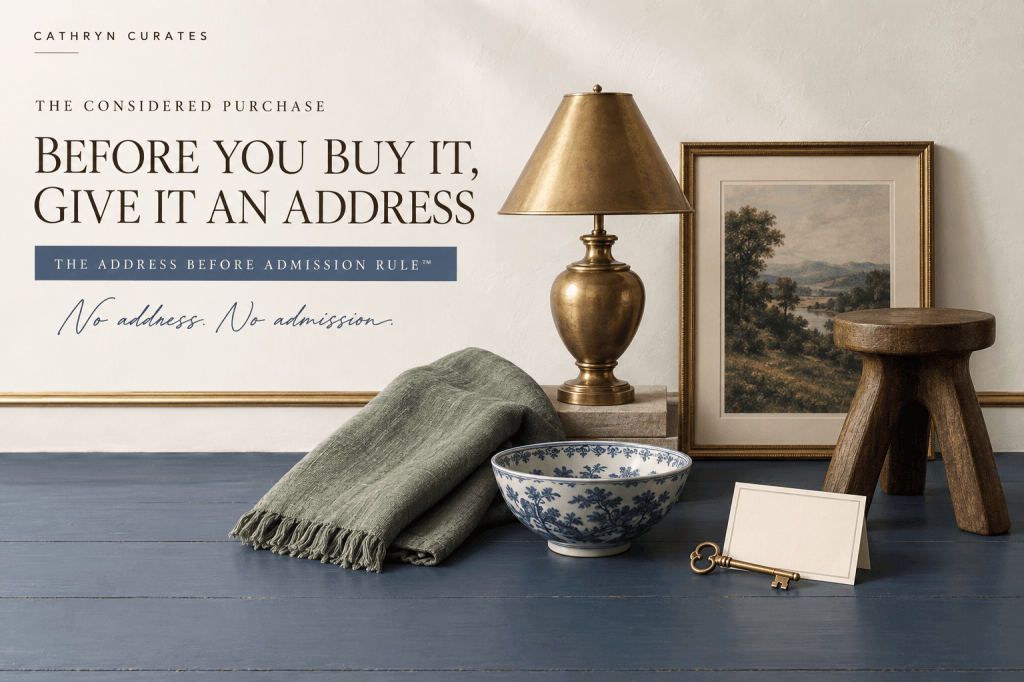
The Address Before Admission Rule™
Before purchasing something for your home, answer three questions:
- Where, exactly, will it live?
- What will it replace or displace?
- Am I willing to care for it properly?
If you cannot answer those questions, the item is not ready to enter the house.
No address. No admission.
I mean it! No means No!
This is not about removing beauty, spontaneity, or pleasure from shopping. It is about protecting our homes and resources from purchases that are lovely in isolation but unnecessary in context.
Because “beautiful” and “belongs in my house” are not synonyms.
Question One: Where, Exactly, Will It Live?
“I think it could work in the living room” is not an address.
An address is specific:
- On the left side of the living-room console
- Above the dresser in the guest bedroom
- Inside the second drawer beside the stove
- At the foot of the primary bed
- On the open shelf between the two blue books
- Inside the hall closet on the upper right shelf
The more specific the answer, the more likely the purchase has been considered in relation to your actual home.
Before buying, look at the intended location. Measure it. Notice the surrounding colors, scale, materials, and objects already occupying the space.
Then ask:
- Does the room genuinely need this?
- Is the scale appropriate? Please I beg you, ask this question.
- Does it work with what is already there?
- Will it improve the room, or simply make it fuller?
- Am I solving a problem or creating a styling assignment?
A gorgeous lamp that is too tall for the table is not a good purchase.
A beautiful chair that blocks the walkway is not an upgrade.
And a decorative bowl that requires evicting three other decorative bowls may be entering a saturated market.
Question Two: What Will It Replace or Displace?
Most of our homes do not suffer from a complete absence of objects. They suffer from the gradual accumulation of objects competing for the same space and purpose.
A new purchase always changes something.
It may replace an item that is worn, broken, uncomfortable, ineffective, or no longer appropriate. That can be a wise and useful upgrade.
But if the new item does not replace anything, it will still displace something:
- Open surface space
- Storage capacity
- Visual quiet
- Walking room
- Cleaning time
- Part of the household budget
This does not mean every purchase requires a rigid one-in, one-out transaction. Homes evolve, needs change, and sometimes a new object adds a function that did not exist before.
It does mean we should acknowledge that nothing enters without occupying something.
Even small objects consume more than physical space. They require attention, cleaning, maintenance, organization, or eventual disposal.
Before buying, identify what will change when the item arrives. If nothing needs to leave, be honest about where the additional volume will be absorbed.
“Somewhere” remains an unacceptable answer.
Question Three: Am I Willing to Care for It?
Well? Are you?
This is the question shopping rarely encourages us to ask.
We consider how an object looks when it is new, styled, polished, and professionally photographed. We do not always consider what it will require after six months of ordinary life.
Before purchasing, ask:
- How will it be cleaned?
- Does it require special maintenance?
- Will the finish scratch, stain, or tarnish?
- Does it need professional cleaning?
- Will pet hair cling to it?
- Is the fabric appropriate for the room?
- Can replacement parts be purchased?
- Will I still value it when it is no longer pristine?
A cream bouclé chair may be gorgeous. It may also be an act of open hostility toward a household containing children, red wine, or a dog who considers all upholstered furniture part of his inheritance.
The right question is not whether an item can be maintained under ideal conditions.
The question is whether you are willing and able to maintain it in your conditions.
The Rule Applies to More Than Décor
The Address Before Admission Rule™ works across nearly every home category.
Furniture
Confirm the dimensions, pathway, placement, surrounding scale, and function before ordering.
Painters’ tape is remarkably helpful here. Mark the item’s dimensions on the floor and live with the outline for a day or two.
If everyone must turn sideways to pass it, the room has submitted its review.
Decorative objects
Identify the exact surface and decide what will be removed or rearranged. Consider whether the room needs another object or more negative space.
A room does not become more finished each time something is added. Eventually, it merely becomes more occupied.
Linens
Know where additional towels, sheets, blankets, and table linens will be stored.
If the linen closet is already negotiating with gravity, buying another blanket because it looks cozy is not entirely a blanket decision. It is also a storage decision.
Kitchenware
Determine where the appliance, pan, serving piece, or utensil will live and how often it will be used.
A single-purpose appliance should solve a recurring problem—not create a recurring search for cabinet space.
Seasonal decorations
Identify both the display location and the off-season storage location.
Every seasonal object spends more time stored than displayed. If we only plan for its six festive weeks and ignore the other forty-six, we have not considered the whole purchase.
Put Space on the Shopping List
When we shop for our homes, we usually think about what we want to add.
We should also consider what we want to preserve:
- Empty space
- Calm surfaces
- Easy movement
- Manageable storage
- Simple cleaning
- Financial breathing room
Space has value, even though no retailer has found a way to place it in a shopping bag.
A room with a little restraint often feels more elevated than one filled with individually lovely things. The eye needs somewhere to rest. The people do, too.
Before purchasing another object, ask whether the room needs more—or whether its current beauty needs room to be seen.
Use a Cart Pause
Online shopping allows desire to move much faster than judgment.
The item appears. The discount expires at midnight. Inventory is allegedly low. A countdown clock begins behaving as though national security is involved.
Pause anyway.
For nonessential home purchases, leave the item in your cart or save the link for at least twenty-four hours. For expensive furniture, lighting, rugs, or art, wait longer.
During the pause:
- Measure the intended location
- Compare the item with what you already own
- Review materials and care instructions
- Read the return policy
- Check customer photographs
- Calculate the complete cost
- Answer the three Address Before Admission questions
If the item still makes sense after the urgency has faded, it may be worth considering.
If you forget about it completely, the sale has performed a small miracle on your behalf.
Beauty Is a Legitimate Purpose
Thoughtful purchasing does not require us to justify every object through strict utility.
Beauty has value.
Art can bring meaning to a room. A vase can make ordinary flowers feel special. A thoughtfully chosen lamp can transform the atmosphere of an evening. A chair can be both useful and extraordinarily beautiful.
The goal is not to reduce the home to objects that can survive a courtroom cross-examination.
The goal is to choose beauty intentionally rather than accumulating it indiscriminately.
An object may earn its place because it serves a practical purpose, creates genuine delight, carries personal meaning, or contributes something important to the room.
It simply needs an honest reason—and an address.
A Christian Note on Contentment
Contentment does not require us to reject beautiful things. It frees us from expecting beautiful things to make us whole.
“But godliness with contentment is great gain.”
— 1 Timothy 6:6, KJV
A purchase can be enjoyed with gratitude when it is made wisely and received without allowing desire to rule us. The problem is not appreciating beauty. The problem comes when constant comparison convinces us that what God has already provided is never quite enough.
Contentment gives us the freedom to admire something without needing to own it.
It allows us to say, “That is beautiful,” without immediately asking where to enter the credit-card number.
Final Thought
Before the next lovely thing enters your cart, give it an address.
Know where it will live. Decide what it will replace or displace. Be honest about whether you are willing to care for it.
If it serves the home, fits the space, respects the budget, and remains beautiful after the urgency has passed, it may deserve admission.
If not, allow it to be beautiful somewhere else.
Admiration is free. Storage is not.
No address. No admission.
Live beautifully. Choose wisely.
Join the Edit
If you enjoy beautiful things but prefer to bring them home with your judgment fully operational, join The Cathryn Curates Edit.
Each week, I share thoughtfully curated finds, practical home guidance, honest product evaluations, and smarter ways to choose what deserves your money, attention, and space.
Fewer, better, more beautiful choices—with no artificial urgency and very few decorative emergencies.

